


Get our report on investing trends!
By providing your email, you will shortly receive the latest report from Pepper.
When a secondaries portfolio has exposure to 2,000 underlying portfolio companies across 100 funds, no manual process maintains meaningful monitoring visibility — AI provides the systematic coverage that human triage cannot.


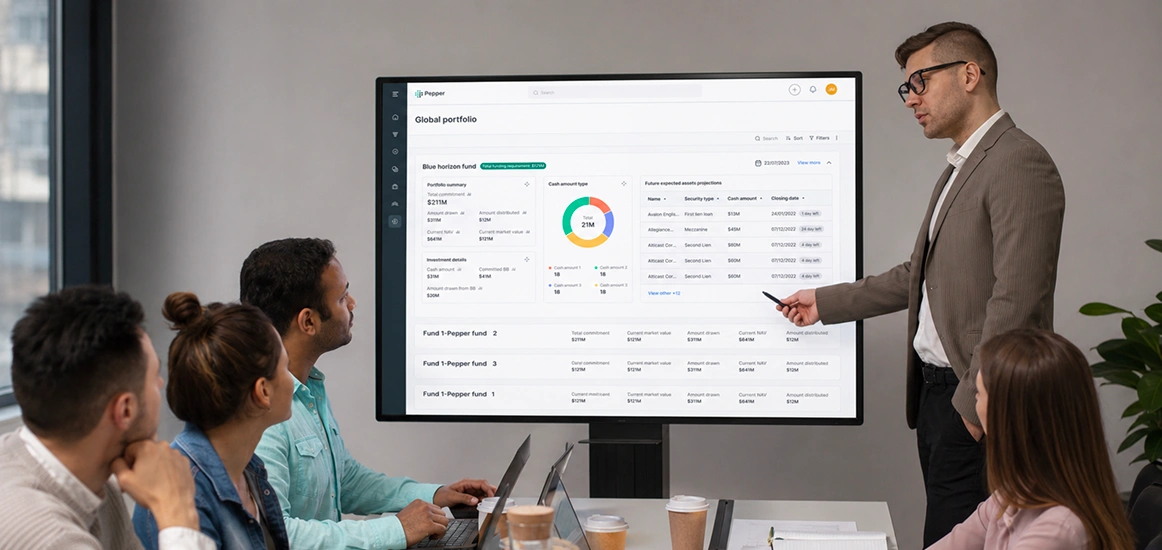
A secondaries manager with 100 underlying fund positions has indirect exposure to between 500 and 2,000 underlying portfolio companies. Each of those companies has its own financial performance trajectory, sector dynamics, and risk profile. Each is reported on by its GP, on the GP’s schedule, in the GP’s format, at whatever level of disclosure the GP chooses to provide.
No human monitoring process maintains meaningful visibility into 2,000 underlying companies through two layers of intermediation. The best manual processes establish a triage framework: identify the largest underlying company exposures by position size, monitor those through direct GP engagement, and rely on quarterly GP reports for everything else. This is a rational operational response to an impossible monitoring problem. It also creates a systematic monitoring gap in exactly the positions where the monitoring gap matters most — the smaller, less-tracked positions in lower-quality GPs, which are also the positions most likely to generate negative surprises.
AI-powered secondaries portfolio monitoring addresses the underlying company visibility problem through two distinct layers that operate simultaneously on different data inputs and detect different categories of risk.
As GP reports arrive, AI analyses the aggregate metrics they contain and compares them against historical patterns for that fund, against comparable funds at similar vintages and strategies, and against expected ranges given current market conditions. The signals this layer produces: a fund whose marks have been unusually stable through a period of sector-wide stress, suggesting marks are not being updated to reflect current conditions; a fund whose realisation pace is inconsistent with the stated exit strategy for the remaining portfolio; period-over-period NAV changes that are not explained by reported portfolio company performance. These signals do not require access to underlying company data — they are derived from GP-reported aggregate metrics and from what the pattern of those metrics over time reveals about mark quality and portfolio management practices.
For the secondaries manager’s largest underlying company exposures, and for the portfolio companies in GP-led continuation vehicles where direct monitoring access is available, AI applies the same financial deterioration detection that operates in direct lending portfolio monitoring: margin compression trends, working capital deterioration, EBITDA variance against historical performance, free cash flow generation against model. The signals at this layer are earlier and more specific than what GP quarterly report aggregates can reveal — because they come from monthly management accounts and operational KPIs rather than quarterly fund-level marks.
The two layers address complementary risk categories. Fund-level monitoring detects GP reporting quality issues, mark methodology concerns, and portfolio-level anomalies. Company-level monitoring detects operational deterioration at individual portfolio companies before it surfaces in GP-reported marks — which, for Level 3 private equity valuations, may be one to two quarters behind the underlying reality.
In direct lending, an AI early warning signal creates specific intervention options: call the borrower, negotiate an amendment, adjust the portfolio’s risk posture. The signal is actionable because the lending manager has direct contractual relationships with the borrower that create real remediation levers.
In secondaries, the early warning signal creates different — and more limited — options. For LP stake positions, the options are: request a GP call to understand their monitoring approach to the flagged portfolio company; adjust the NAV estimate for the affected fund position; factor the observed deterioration into pricing for any related secondary market transaction. For GP-led continuation vehicle positions, the options include direct engagement with company management, which provides more intervention levers.
The value of early warning in secondaries is primarily informational rather than remedial. Knowing that a portfolio company in a fund position is showing three consecutive quarters of EBITDA compression before the GP formally marks down the fund allows the secondaries manager to: adjust their own NAV estimate for the position rather than waiting for the GP mark; communicate the adjustment proactively to LPs rather than reacting to the formal mark; engage the GP proactively with specific questions about their monitoring approach; and factor the developing situation into portfolio risk assessments.
“In secondaries, early warning is more informational than remedial. The value is not that it enables direct intervention — it is that it enables preparation: adjusted NAV estimates, proactive LP communication, informed GP engagement, and accurate portfolio risk assessment before the formal mark arrives.”
Fund-level monitoring requires a structured, normalised database of GP-reported metrics across all underlying fund positions, updated continuously as GP reports arrive and processed through AI format-independent ingestion. This is the same data infrastructure as the GP report aggregation capability described in other pieces in this series.
Company-level monitoring requires a direct link between fund-level position data and underlying company data — a data model that captures which fund positions have meaningful exposure to which underlying companies, and routes company-level financial data (when available) to the relevant position monitors. This capability is not present in most secondaries portfolio management platforms, which track fund-level data without the underlying company layer that enables company-level monitoring.
The platforms that provide both layers — fund-level AI monitoring from normalised GP reports and company-level AI monitoring for the largest underlying exposures — are the platforms on which full two-layer secondaries portfolio intelligence is achievable. The platforms that provide only the fund-level layer leave the most important monitoring gap — the underlying company performance dynamics that precede GP mark adjustments — unaddressed.
Pepper’s secondaries monitoring operates at both layers simultaneously. Fund-level anomaly detection from normalised GP-reported data. Company-level financial deterioration detection for the manager’s largest underlying company exposures and for GP-led continuation vehicle portfolio companies. Both layers draw from the same governed, continuously updated data layer as portfolio construction, valuation, and LP reporting.

Articles
August 20, 2026

Articles
August 20, 2026

Articles
August 20, 2026
Sign up for our newsletter to receive biweekly updates on the world of asset management, delivered straight to your inbox.

By providing your email, you will shortly receive the latest report from Pepper.
In a 45-minute session, we'll walk you through how Pepper handles the workflows your team runs today — deal management, portfolio monitoring, fund operations, or LP reporting. You pick the priority.
Not a sales call. A 30-minute conversation with a Pepper practitioner about where your operation is today, where the pressure points are, and whether a platform approach makes sense for your stage of growth.