


Get our report on investing trends!
By providing your email, you will shortly receive the latest report from Pepper.
An industry perspective for operations, technology, and investment leaders



Private credit is, at its operational core, a document business. A single loan generates parallel document streams across its life — credit agreements and amendments, agent bank notices, borrower financials, compliance certificates, borrowing base reports, and audited accounts. A mid-market fund with 30–50 borrowers receives 300–600 of these every month. None of it arrives as data. It arrives as documents, and the translation from document to data is performed, at most firms, by a human being.
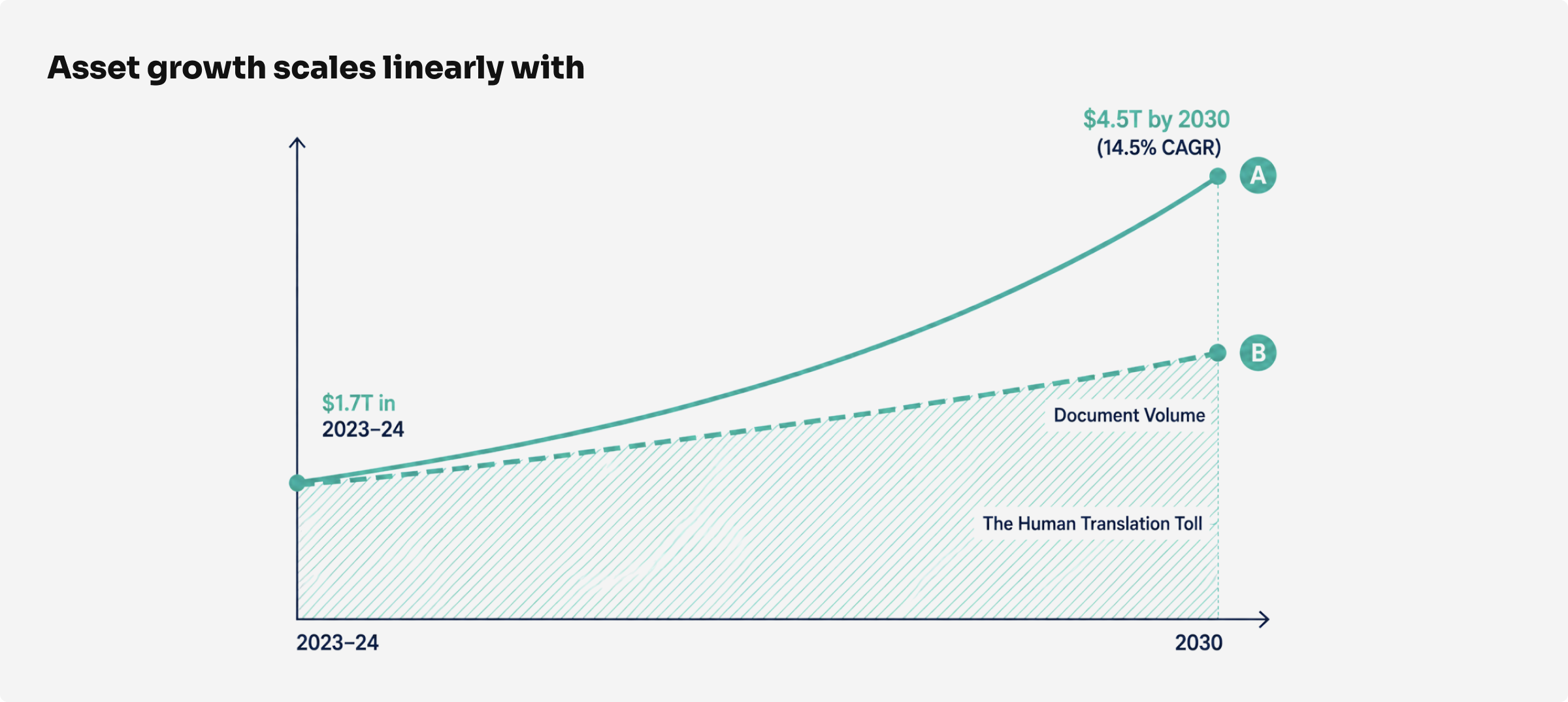
The scale of this problem is now an industry-level concern. Private credit AUM has grown roughly tenfold since 2009 to nearly $1.7 trillion, and Preqin projects it will reach $4.5 trillion by 2030 — compounding at a pace (roughly 14.5% annualized over the past decade) that far outstrips bank lending. Every dollar of that growth arrives wrapped in documents, and the operations model most firms use to process them scales by adding people, not infrastructure. Meanwhile, an estimated 80–90% of the useful information inside any organization sits in unstructured sources — emails, PDFs, scanned attachments — precisely the formats private credit runs on.
This is not a problem of effort. It is a problem of capability. For thirty years, the tools available to automate document processing could read characters but not understand them — and private credit documents demand understanding, because the same economic fact appears under a dozen different names, in a dozen different layouts, across a dozen different counterparties. What changed is measurable. Document AI research has produced models that, on standard benchmarks, lift field-extraction accuracy from the mid-60s to the nearly 99.9% by modeling layout and visual structure rather than text alone. That is the gap between a system that needs constant human correction and one that does not.
The private credit ingestion problem is a semantic understanding problem, not a document-handling one. The reason a decade of OCR, templates and RPA failed is that none of them modeled meaning — and the research record now quantifies exactly how much that costs in accuracy. The reason it is now solvable is that document-AI models jointly represent text, spatial layout and visual structure, and can be adapted to the specific vocabulary of private credit. Understanding how those models work — and how to measure whether they work — is now a core competency for any operations or technology leader in this market.
Private credit data arrives from counterparties who have no incentive, and often no capability, to standardize their outputs. A single performing loan generates credit agreements and amendments, agent bank notices, borrower financials, compliance certificates, borrowing base reports, waiver letters, and audited accounts — each from a different sender, in a different format, with different field names for the same underlying concept. Across a 30–50 borrower portfolio, that totals 300–600 documents a month, and every one of them is structured according to the preferences of its originator, not the requirements of its recipient.
The macro context makes this urgent rather than merely annoying. The chart below frames the collision: an asset class growing at double digits, a document burden that scales linearly with it, and an operations model that — left unchanged — turns growth into proportional cost.
| Industry data point | Figure |
|---|---|
| Global private credit AUM (2023–24) | ~$3 trillion |
| Projected private credit AUM by 2030 | ~$4.5 trillion |
| Private credit 10-yr annualized growth | ~14.5% (vs. ~3% for bank C&I loans) |
| Useful enterprise information that is unstructured | 80–90% |
| Intelligent Document Processing market CAGR | ~25–33% through early 2030s |
| Largest IDP adoption vertical | BFSI (financial services) |
The translation from document to data is performed, at most firms, by a human analyst executing a workflow that has not materially changed in a decade: open, read, cut & page, validate, reconcile, repeat. The visible cost is headcount. The consequential cost is latency — when extraction is manual, covenant checks happen quarterly instead of continuously, LP reports take weeks instead of hours, and investment decisions are made on information that is already stale. Only one of these two costs appears in a budget line.
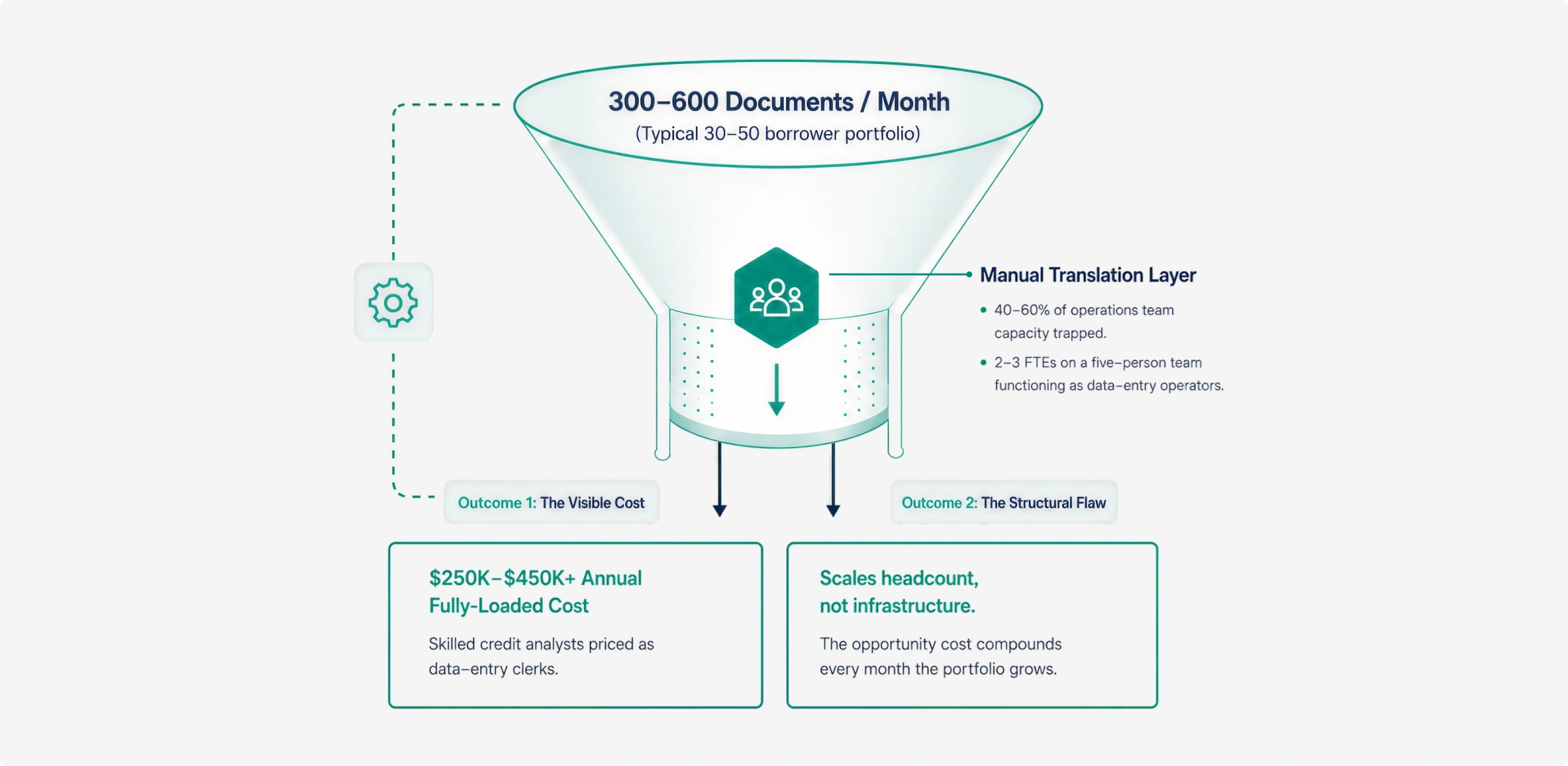
The two costs of manual ingestion break down across four line items. A 30–50 borrower portfolio takes in 300–600 inbound documents a month — notices, financials, certificates, borrowing base reports, and amendments. Processing them consumes 40–60% of the operations team’s capacity on collection, extraction, and reconciliation, which works out to roughly 2–3 FTEs on a five-person team. The fully-loaded cost of those FTEs runs $250K–$450K+ per year — skilled analysts effectively priced as data-entry operators. And beyond all of that sits the cost of data latency: unbudgeted, and larger than the rest — the price of quarterly covenant checks, lagged analytics, and multi-week LP reporting.
To understand why automation has only now become viable, it helps to see document processing as a research lineage rather than a product category. Each generation solved a deeper layer of the problem — and, critically, the research record now lets us measure how much each layer is worth. The single most important number in this paper is the accuracy gap between a model that reads text alone and one that also models layout.
Optical character recognition (OCR) converts the pixels of a scanned page into a stream of characters. Modern OCR — including transformer-based systems such as TrOCR — is extremely accurate at this narrow task. But a character stream has no structure and no meaning. An OCR transcript of a compliance certificate is a text file, not data: it does not know that a number near the word “leverage” is a covenant measurement, or that two figures on the same row are a defined term and its threshold. Every interpretive step still falls to a human. OCR solved legibility. Private credit has a meaning problem.
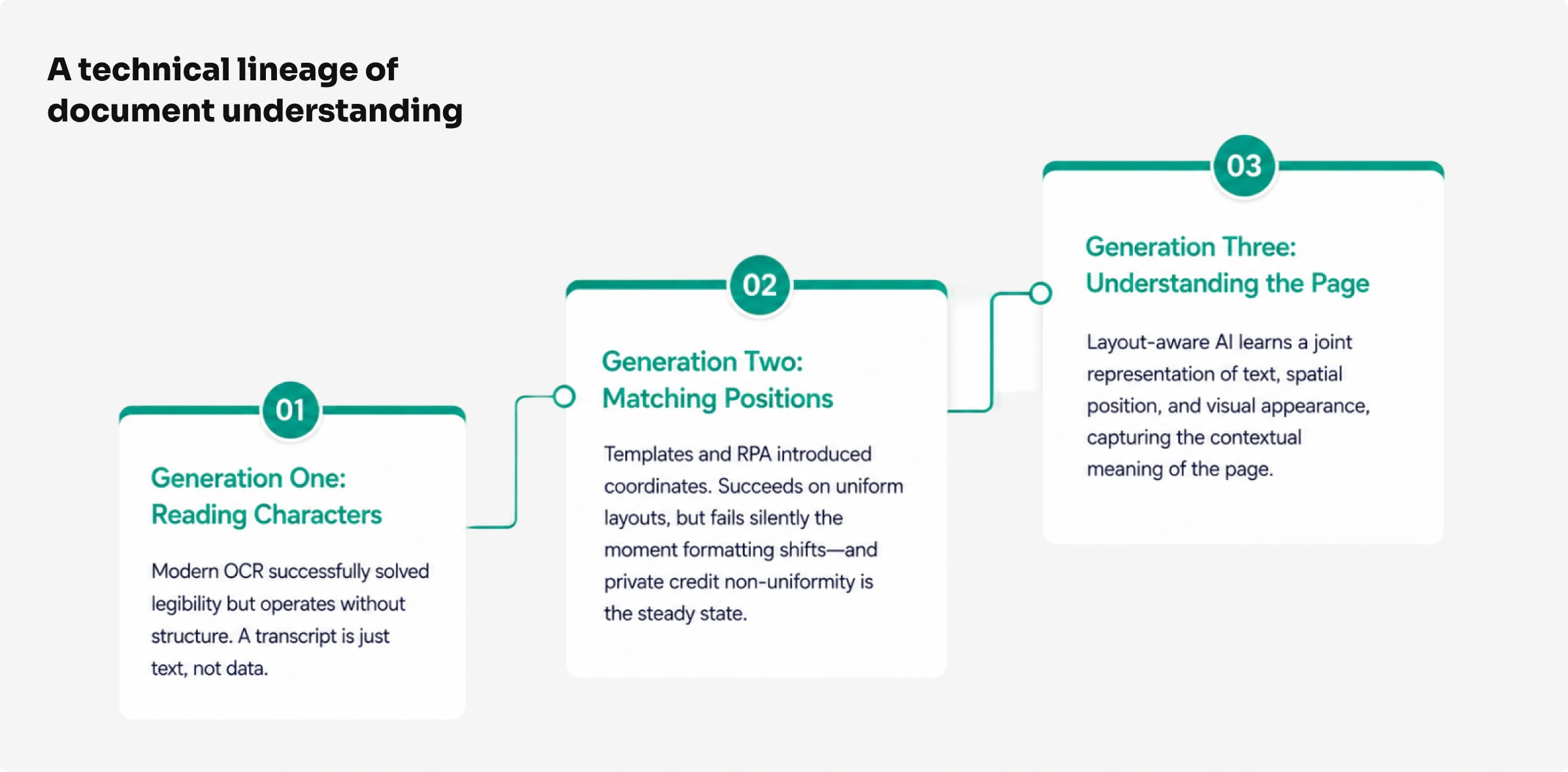
Template extraction and robotic process automation (RPA) added a thin layer of structure: a field is whatever sits at a known coordinate, and a workflow is a fixed sequence of keystrokes against a known screen. This works precisely when documents are uniform — and breaks the moment they are not. In private credit, non-uniformity is the steady state. Every agent bank, every borrower CFO, and every law firm formats differently, so each new layout becomes a new template and each upstream change silently breaks a script. The defining failure mode is silence: a positional system that misses a field usually does not announce it, which in a covenant context turns a data error into a missed breach.
The breakthrough of the last five years is the recognition that a document is a two-dimensional object: meaning is encoded not only in the words but in where they sit relative to one another. A figure is an “advance rate” because of the column it is under and the row it is beside — spatial context a linear text model discards. Layout-aware transformer models — the LayoutLM family from Microsoft Research, among others — learn a joint representation of three signals at once: the text, the two-dimensional position of each token, and the visual appearance of the page.
A parallel research line removes the OCR step entirely: OCR-free models such as Donut (NAVER/Clova) and Nougat (Meta AI) read the raw page image and emit structured output directly, eliminating the compounding errors that occur when an OCR mistake is passed to a separate extraction model.
The effect is not subtle, and it is documented on public benchmarks. On FUNSD — a standard form-understanding dataset measuring how accurately a model extracts labeled fields — a strong text-only language model (RoBERTa) scores roughly 66 F1. The same task, given to a layout-aware model that adds spatial and visual signal (LayoutLMv3), scores about 90–92 F1, and on the cleaner CORD receipt-parsing benchmark the high-90s. The durable finding here is the roughly 25-point lift from adding layout — the empirical core of this paper — not the absolute high-90s figure itself.
That absolute number deserves a sharp caveat, because it is easy to misread. FUNSD and CORD are clean, curated, largely single-page documents — short forms and receipts — and benchmark F1 measured on them is an upper bound under near-ideal conditions, not a production guarantee. The documents a credit firm actually receives are longer, messier, and more semantically complex: a forty-page borrowing base report or a twice-amended credit agreement bears little resemblance to a receipt, and field-level accuracy on real private credit documents is typically lower and more variable than any public benchmark suggests. The benchmarks establish relative capability — layout beats text — not the score a firm should expect on its own mail.
Nor is “high-90s” self-evidently “good enough.” A covenant measurement extracted at 96% accuracy is still wrong roughly one time in twenty-five — unacceptable on its own in a context where a single missed figure is a missed breach. The benchmark proves the underlying capability exists; it is the architecture built around that capability — calibrated confidence scoring, private-credit domain validation, and a human-in-the-loop exception path, all developed in Sections 4 and 5 — that converts a high-but-imperfect model into a workflow a firm can actually trust. High-90s is the starting point for a governed pipeline, not a license to auto-confirm.
| Model | What it models | FUNSD F1 (form extraction) | CORD F1 (receipt parsing) |
|---|---|---|---|
| BERT (base) | Text only | ~60 | ~90 |
| RoBERTa (base) | Text only | ~66 | ~94 |
| LayoutLMv3 (base) | Text + layout + image | ~90 | ~97 |
| LayoutLMv3 (large) | Text + layout + image | ~92 | ~97 |
When evaluating any document-automation claim, the first diagnostic question is: what does the model actually represent? The benchmark record is unambiguous — text-only systems plateau in the mid-60s on form extraction, while layout-aware systems reach the low-90s. A system that models only characters (OCR) or only positions (templates) will fail on private credit documents no matter how it is marketed. The capability that matters is a joint representation of text, layout, and visual structure. But treat published benchmark scores as evidence of relative capability, not as the accuracy you will see in production — a vendor quoting high-90s on standard datasets has shown the model can be capable, not that it is safe on your documents. That requires the calibration and validation discussed next.
Layout-aware understanding lets a model see a page correctly. Two further research advances turn that capability into investment-grade data for a specialized domain like private credit: adapting models to the domain’s vocabulary, and resolving the same economic entity across its many surface forms.
Language and document models acquire their abilities from the corpora they are trained on. A model pretrained on general web text has seen the word “margin” used in a hundred unrelated senses and has no particular reason to associate it with a pricing grid, or to distinguish net leverage from total leverage, or to know that “FCCR” and “fixed charge coverage ratio” are the same metric. Domain adaptation — continuing to train, or fine-tuning, a model on in-domain financial text — closes this gap. Finance-adapted language models such as FinBERT demonstrate this effect: on financial-language tasks, domain-pretrained models consistently outperform general-purpose ones, because the domain’s vocabulary and its statistical regularities are baked into the representation rather than approximated at inference time.
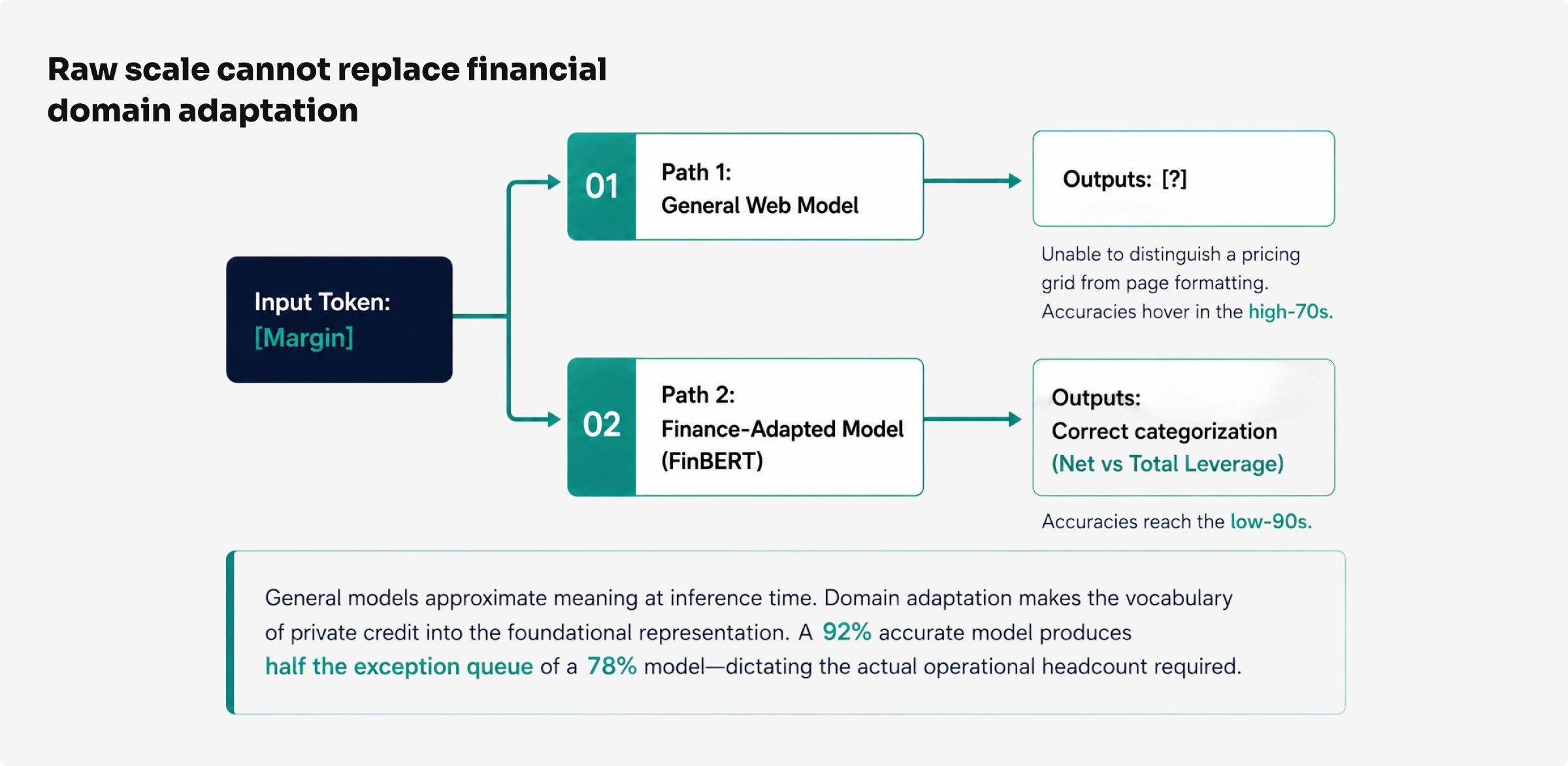
The size of the gap is best understood not as a quality nicety but as a routing decision: it determines what share of documents a system can resolve automatically versus what share it must escalate to a human. Independent evaluations on specialized terminology commonly report domain-adapted accuracy in the low-90s against high-70s for general-purpose models — and that spread compounds. A model at 92% accuracy produces roughly half the exceptions of one at 78%, and the exception queue is the single largest driver of residual human cost in any deployment.
Extraction tells you what a document says. Normalization tells you what it means in your data model. The same economic concept arrives as “Applicable Margin,” “Spread,” and “Pricing Grid Rate”; the same borrower appears under its pre-acquisition and post-acquisition names; the same instrument is described five ways across five counterparties. Resolving these to a single canonical field is a semantic problem, and the research tool for it is the embedding: a model that maps text into a high-dimensional vector space where semantically similar terms sit close together regardless of surface wording. “First Lien T/L” and “Senior Secured Term Loan” share almost no characters, but a domain-tuned embedding places them near-adjacent.
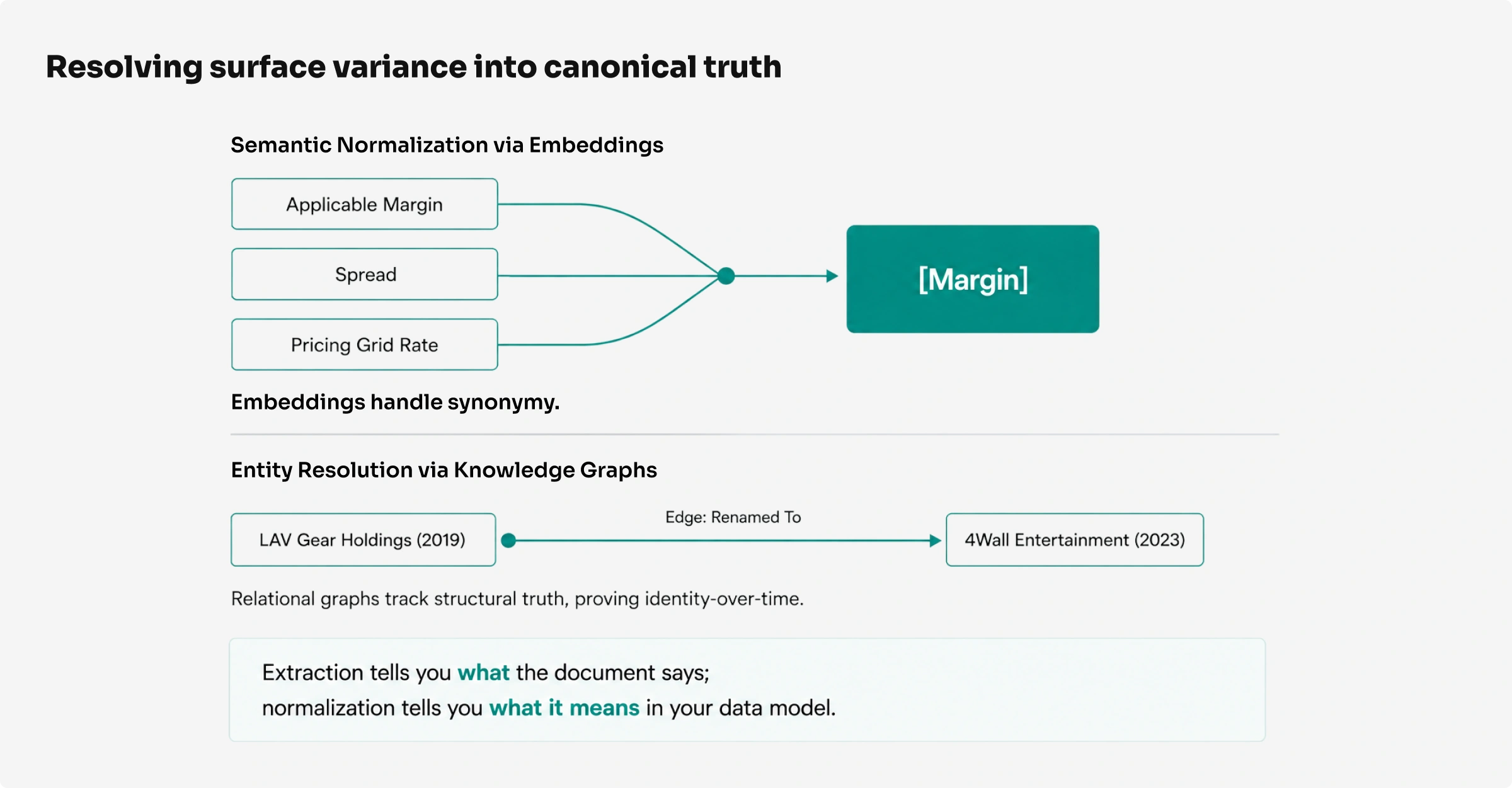
Embeddings handle synonymy and paraphrase. They do not, on their own, handle identity-over-time — the fact that “LAV Gear Holdings” and “4Wall Entertainment” are the same economic entity at different points in its corporate history. That requires a complementary structure: a knowledge graph that records acquisitions, renamings and restructurings as explicit relationships, so the system can reason about entity identity rather than merely measure string or semantic similarity. The state of the art combines the two — embeddings for semantic proximity, graphs for relational truth — and research on graph-enhanced document understanding shows a measurable precision lift over embedding-only approaches. The lesson generalizes: meaning and relationship are different problems, and a serious system addresses both.
Accuracy on your documents is not a property of the model alone — it is a property of the model plus the domain it was adapted to plus the normalization layer that maps its output to your fields. A frontier general-purpose model with no domain adaptation and no entity-resolution layer will lose to a smaller, finance-tuned system wired to a knowledge graph. When the question is private credit, fit to the domain beats raw scale.
The research above becomes useful only when assembled into a pipeline that is accurate, auditable, and able to improve itself. A well-designed ingestion system spans five stages, each building on the last, with a domain-validation layer beneath them and a human-in-the-loop exception path running alongside. Notably, market research now identifies the human-in-the-loop pattern itself as a primary driver of IDP adoption — the field has converged on the view that the machine and the analyst belong in the same loop, not in sequence.
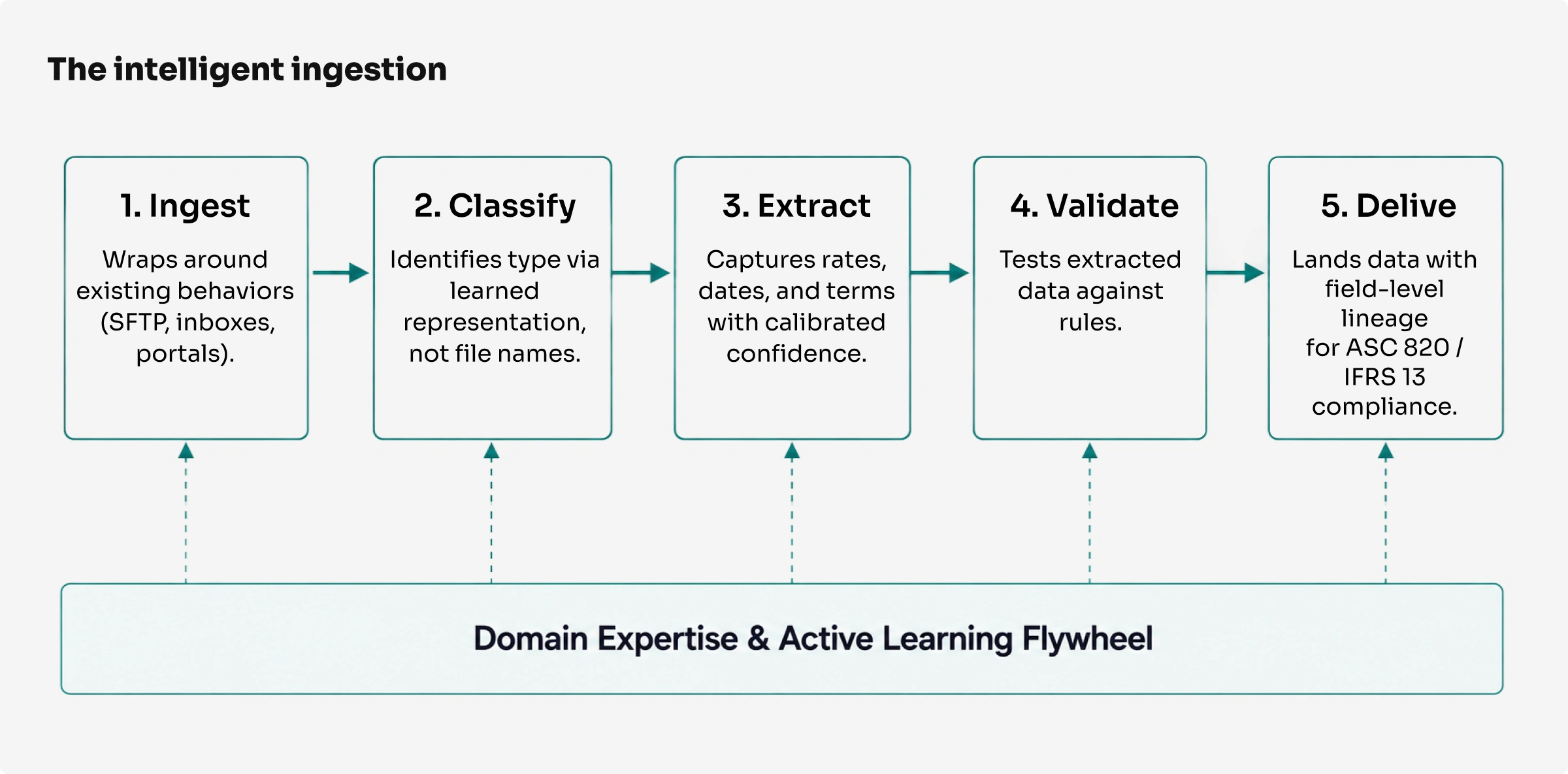
The validation stage is where generic document AI becomes private-credit document AI, so it is worth making its logic explicit. Validation is not a single check but a layered set of them, each encoding a different kind of domain knowledge:
| Validation layer | What it encodes | Failure it catches |
|---|---|---|
| Term normalization | That synonymous fields across counterparties are one canonical field. | The same metric is stored under three names, fragmenting analytics. |
| Internal arithmetic | Those derived figures must tie to their components. | A borrowing base total that does not equal the sum of its categories. |
| Cross-document consistency | Those related documents must agree. | A certificate leverage figure that contradicts the financials it cites. |
| Threshold testing | Those measurements must be checked against agreement covenants. | A covenant breach invisible until the next quarterly review. |
Table 4 — Validation is where domain knowledge becomes code. Generic field-type checks do not reach this level.
None of this changes the existing manual workflow incrementally; it replaces its foundation. And it carries a second-order consequence worth stating plainly: structured, lineage-tracked data is the precondition for any AI a fund might later deploy on its portfolio. AI that reasons from unvalidated, manually-keyed inputs inherits their error rate. AI that reasons from a validated, audited data layer is the only version a credit committee should trust with anything consequential.
Two design questions separate a research demo from a production system: can the model tell you when it is unsure, and does it get better as it runs? Both have well-studied, quantitative answers, and both are where many deployments quietly fail.
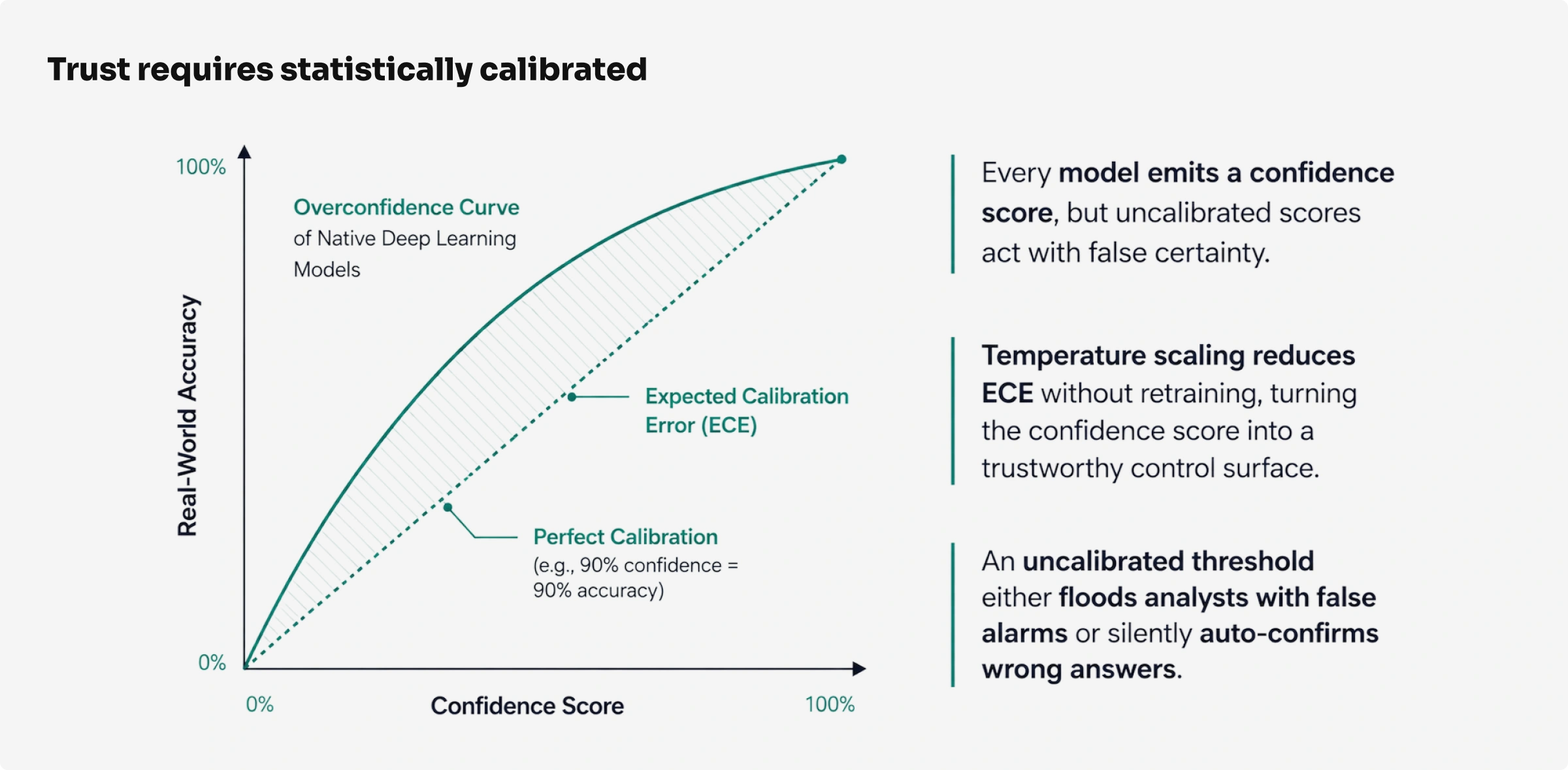
Every modern extraction model emits a confidence score, but a raw score is not the same as a probability. A model is well-calibrated when its stated confidence matches its real-world accuracy — when the fields it marks 90% confident are correct 90% of the time. The standard measure is Expected Calibration Error (ECE), the average gap between confidence and accuracy across confidence bands. Research on neural network calibration (Guo et al., ICML 2017) showed that modern deep models are frequently overconfident out of the box and introduced lightweight corrections such as temperature scaling that can reduce ECE substantially without retraining the model. In a covenant context this is not academic: the entire auto-confirm-versus-escalate decision rests on the confidence threshold, and an uncalibrated model either floods analysts with false alarms or silently auto-confirms wrong answers. Calibration is what makes the confidence score a trustworthy control surface rather than a decorative number.
The exception queue is usually described as a safety net. It is more accurately understood as the system’s primary learning mechanism. Active learning is a well-established result in machine learning: a model improves fastest not when fed random examples, but when fed the specific examples it is most uncertain about — a strategy known as uncertainty sampling, shown across the literature to reach a target accuracy with far fewer labeled examples than random sampling.
An exception queue built around calibrated confidence does exactly this automatically. It surfaces to the analyst precisely the documents at the model’s decision boundary, and each correction becomes a high-value labeled example that teaches the model where it was weak. Over time, the volume of exceptions declines not because the documents got easier, but because the system was trained on the hardest ones first.
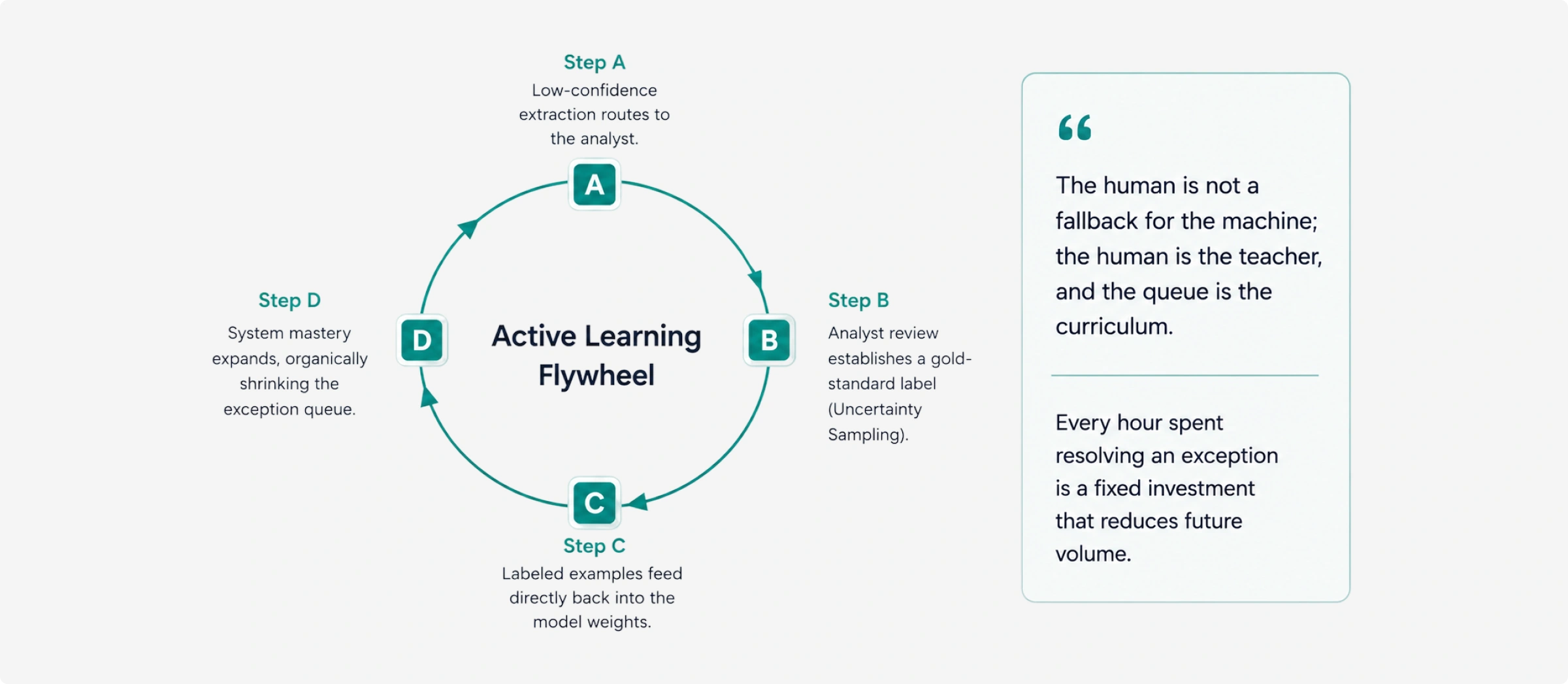
This reframes the economics of human review. In a manual shop, every hour of analyst time is consumed and gone. In a well-architected system, every hour spent resolving an exception is an investment that reduces future exception volume. The human is not a fallback for the machine; the human is the teacher, and the queue is the curriculum.
A claim of “99% accuracy” is meaningless without knowing the accuracy of what, measured. Document-level accuracy is misleading: a document with one wrong field out of forty is not 97.5% useful if that one field is the covenant measurement. The right unit is field-level precision and recall — for each field, how often is an extracted value correct (precision) and how often is a present value captured at all (recall) — combined into an F1 score and tracked per field type against a held-out, human-labeled gold-standard set. This is exactly how the benchmark figures in Section 2 are computed, which is why they are comparable across models and worth insisting on from any vendor.
| Metric | What it answers | Why it matters in private credit |
|---|---|---|
| Field-level precision | When the system reports a value, how often is it right? | A wrong covenant figure is worse than a missing one — it acts with false confidence. |
| Field-level recall | Of the values present in the document, how many were captured? | A silently dropped field is an unmonitored covenant or a missing reserve input. |
| Per-field F1 on a gold set | Combined precision/recall against human-labeled truth, per field type. | Aggregate accuracy hides which specific fields are unreliable. |
| Expected Calibration Error | Does stated confidence match real accuracy? | An uncalibrated threshold either floods or under-flags the exception queue. |
Three questions separate a production-grade system from a demo: Is the confidence score calibrated (low ECE), so the escalation threshold means what it says? Does the exception queue feed corrections back as training data, so the system improves on its own hardest cases? And is accuracy reported as field-level F1 against a held-out gold set, so the number reflects reality? A vendor who cannot answer all three has not solved the problem — they have demonstrated it.
The infrastructure required to deploy a system of this kind must be weighed against the ongoing cost of manual processing. Gartner’s analysis of AI-driven data operations finds AI-enabled ingestion yields 4–6x ROI in Year 1 for mid-tier funds, with 70% time savings in operations functions. The infrastructure cost is measured in tens of thousands of dollars annually; the manual cost it displaces is measured in hundreds of thousands — and the gap widens every quarter, because labor scales with AUM while infrastructure cost is largely fixed. With private credit AUM compounding at double digits, the linear-cost trap is not a steady state; it is a worsening one.
| Variable | Conservative case | Base case | Upside case |
|---|---|---|---|
| Annual labor cost (manual) | $250,000 | $350,000 | $450,000 |
| Automation rate (AI system) | 94% | 98% | 99.9% |
| Residual manual cost | $100,000 | $87,500 | $67,500 |
| Annual infrastructure cost | $30,000 | $30,000 | $30,000 |
| Annual net savings | $120,000 | $232,500 | $352,500 |
| Estimated payback period | ~9 months | ~5 months | ~3 months |
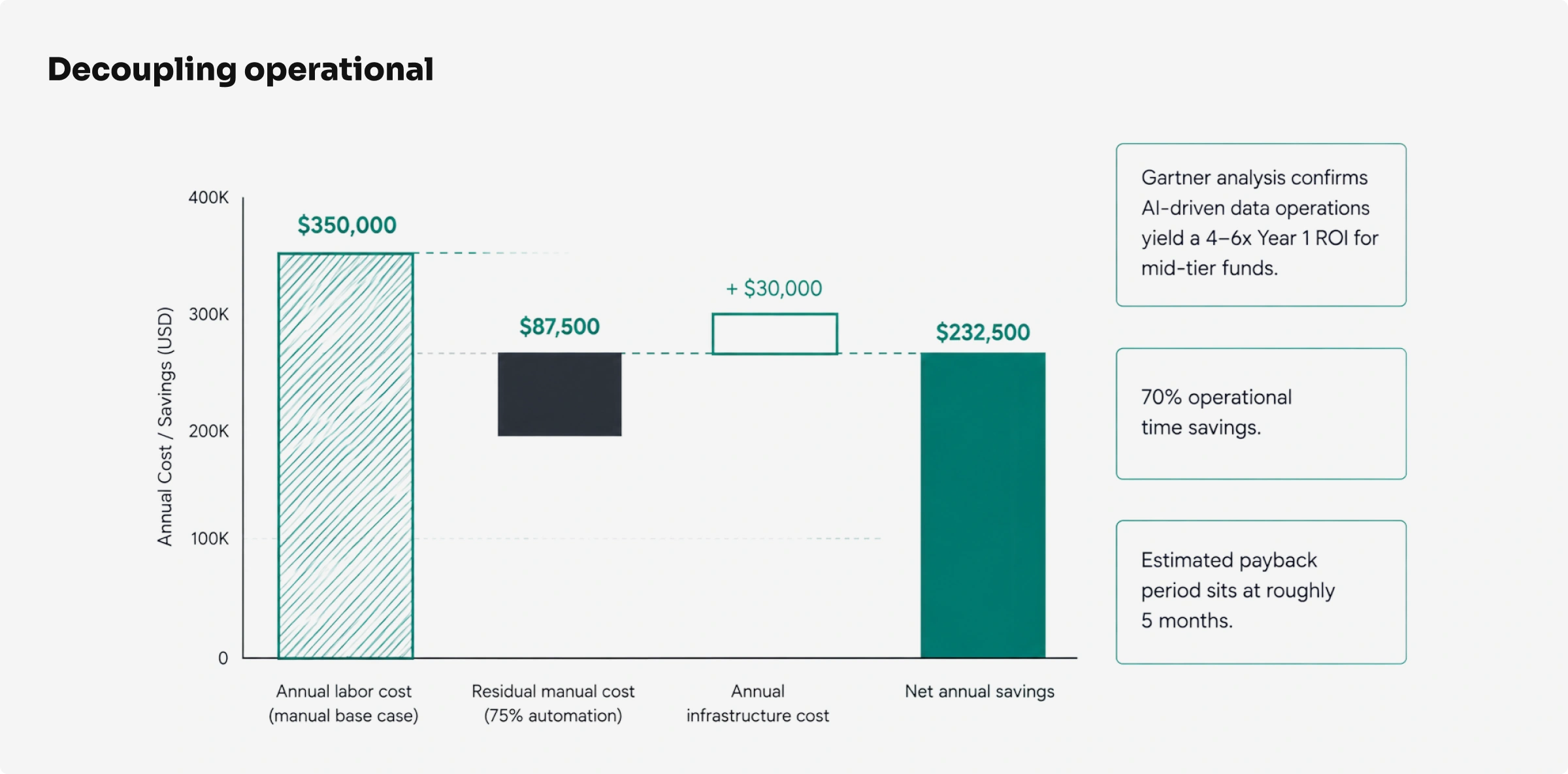
Beyond direct labor, three value drivers do not appear in a simple cost comparison: continuous covenant monitoring reduces the risk of a missed breach — a single missed cure period can dwarf the platform’s annual cost; on-demand reporting with current data is a differentiator as LPs increasingly treat operational quality as a diligence criterion; and the scalability premium compounds, since the marginal cost of the next billion in AUM is near-zero on fixed infrastructure but linear under manual processing.
For COOs and CTOs, several factors warrant attention beyond the technology itself — most of them direct consequences of the research discussed above.
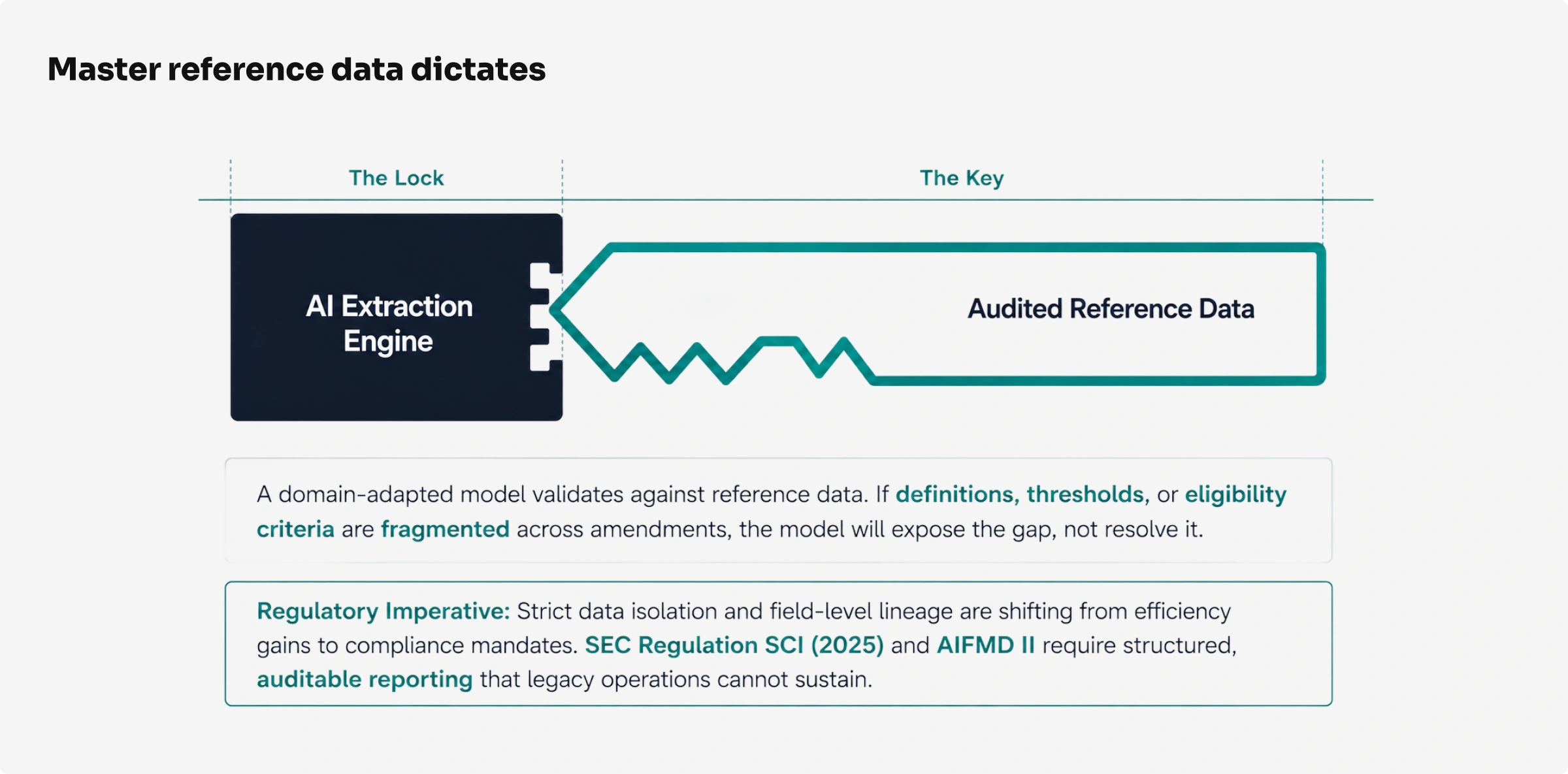
A domain-adapted model is only as good as the reference data it validates against. Before deployment, audit master data — credit agreement definitions, covenant thresholds, borrowing base eligibility criteria — for completeness and currency. A common discovery at this stage is that the authoritative version of a frequently-amended agreement does not exist in one place. The model will expose this gap rather than resolve it, so resolving it first is what allows automated extraction to validate against truth.
Because the confidence threshold is the lever that trades analyst review against silent error, initial deployment should set it conservatively — routing more to human review than the mature system eventually will — with active monitoring of exception and resolution patterns and the calibration error tracked over time. As the field-level evaluation accumulates evidence of where the model is reliable, thresholds can be tightened by document type and counterparty. This is calibration and active learning applied as operational policy, not just model design.
Institutions managing multiple strategies or external mandates must enforce strict data isolation between entities — non-negotiable for operational integrity and compliance. The regulatory environment is reinforcing the case: SEC Regulation SCI updates effective in 2025 mandate automated reconciliation audits for registered entities, and AIFMD II introduces reporting obligations that effectively require structured, field-level auditable data. The lineage architecture that good ingestion produces is increasingly a compliance requirement, not only an efficiency gain — which is part of why BFSI is the largest and fastest-adopting vertical in the intelligent-document-processing market.
Assembling this capability in-house requires simultaneous expertise in layout-aware document AI, domain adaptation, embedding and knowledge-graph entity resolution, confidence calibration, active-learning pipelines, and audit-grade data modeling — plus ongoing maintenance as document formats and corporate events evolve. The individual components are increasingly available as open research and commercial infrastructure, and the IDP market is growing 25–33% a year precisely because firms are choosing to buy rather than build them. The private-credit domain knowledge that configures those components correctly is the scarce ingredient. The honest build-versus-buy question is not whether the technology can be assembled, but whether that domain expertise is a core competency worth owning.
The private credit data ingestion problem went unsolved for so long not because firms lacked effort, but because the technology could read documents without understanding them. That constraint has been lifted, and the benchmark record measures the difference precisely: modeling layout and visual structure rather than text alone lifts form-extraction accuracy by roughly 25 F1 points, from the mid-60s to the low-90s. Domain adaptation tunes that capability to the vocabulary of private credit; embeddings and knowledge graphs resolve the same entity across its many forms; calibration makes confidence trustworthy; and active learning makes the system improve on its own hardest cases.
For an operations or technology leader, the practical takeaway is a sharper set of questions. What does the model actually represent? How was it adapted to this domain? Is its confidence calibrated? Does human review feed back as training data? Is accuracy measured as field-level F1 against held-out truth? A leader who can ask these can tell a system that has solved the problem from one that has merely demonstrated it.
The macro case is unambiguous. Private credit AUM is on track to roughly double to $4.5 trillion by 2030, the document burden will grow with it, and the manual model converts that growth into proportional cost. The funds that treat data infrastructure as a strategic asset — not a cost center — will compound an operating advantage that becomes harder to replicate the longer it is deferred. The cost of building it right is measured in tens of thousands of dollars a year. The cost of not building it — in analyst time, delayed decisions, and regulatory exposure — is measured in multiples of that, every quarter.
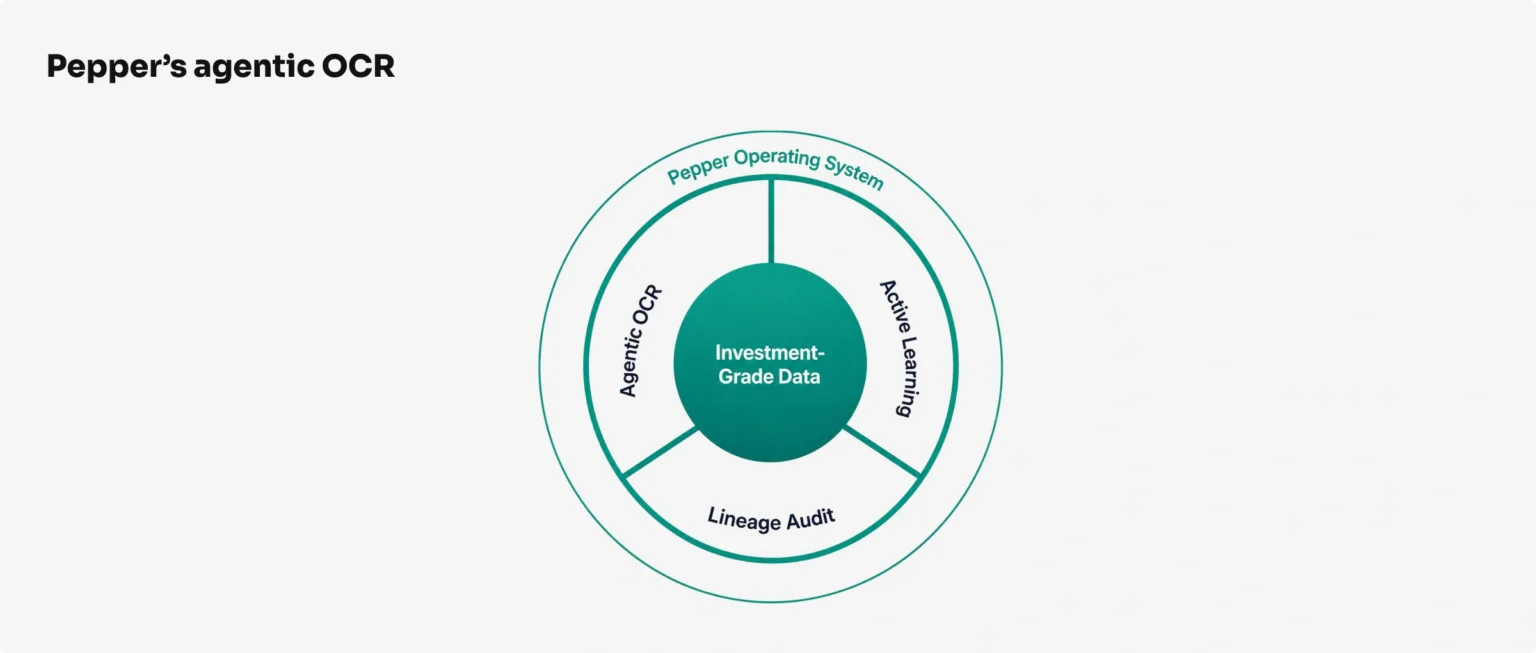
The architecture, benchmarks, and evaluation discipline described in this paper reflect the state of the field, not any single vendor’s product. As it happens, they also describe the approach Pepper has built into its Agentic OCR and Data Platform — a layout-aware, domain-adapted ingestion pipeline with calibrated confidence routing, a human-in-the-loop exception queue that feeds corrections back into the models, and field-level lineage for audit and ASC 820 / IFRS 13 support, applied across the full document spectrum a credit firm receives.
Clients running it report a 70% reduction in data extraction time and new document formats integrated roughly 85% faster than with template approaches; one scaled from $600M across four funds to $4.5B across ten funds without proportional headcount growth, as the data infrastructure absorbed the volume. We share the underlying thinking — and the benchmarks — openly because we believe the market is better served by leaders who can evaluate any system rigorously, including ours.
Pepper is the Operating System for Private Credit — a cloud-native platform purpose-built for alternative asset managers. Pepper unifies deal management, portfolio monitoring, fund operations, investor reporting, and AI-powered analytics into a single integrated system, delivering the data clarity and operational leverage that modern private credit managers require.
onpepper.com
Note: Research and market references are provided for the reader’s further study. Benchmark figures are rounded from published results; market projections vary by source and methodology. Readers are encouraged to consult primary sources directly.

Articles
August 20, 2026

Articles
August 20, 2026

Articles
August 10, 2026
Sign up for our newsletter to receive biweekly updates on the world of asset management, delivered straight to your inbox.

By providing your email, you will shortly receive the latest report from Pepper.
In a 45-minute session, we'll walk you through how Pepper handles the workflows your team runs today — deal management, portfolio monitoring, fund operations, or LP reporting. You pick the priority.
Not a sales call. A 30-minute conversation with a Pepper practitioner about where your operation is today, where the pressure points are, and whether a platform approach makes sense for your stage of growth.