





Thought Leadership
July 29, 2026


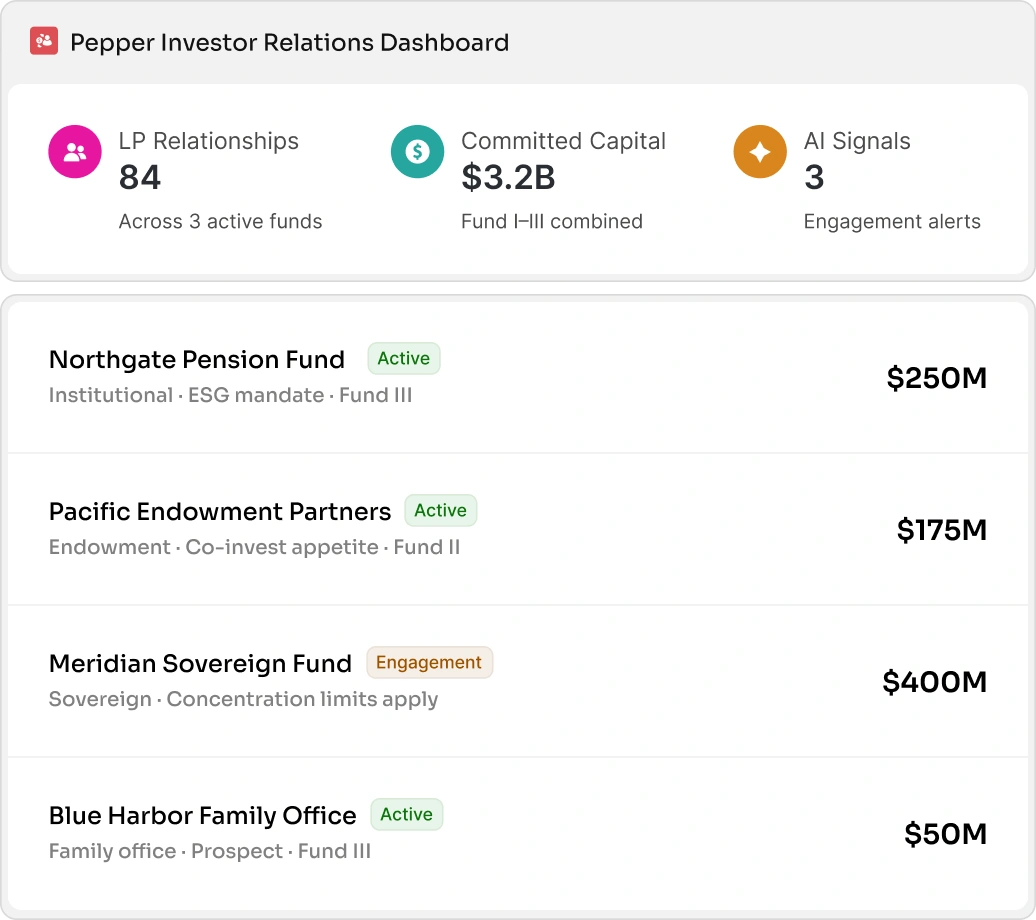

Pepper's IR module centralises every LP relationship, allocation record, communication log, and reporting obligation in one system — so your IR team works from the same data as your investment team. The most common IR failure in private credit isn't a relationship failure — it's a data failure.


 IR team pulls LP allocation data from fund admin — investment team uses a
separate model.
LP asks about their exposure — IR takes 2 days to get a verified
answer.
Communication history spread across individual inboxes — no shared
relationship record.
Quarter-end LP report assembled manually from 4+ data sources.
ESG compliance tracked in spreadsheets separate from portfolio data.
IR team pulls LP allocation data from fund admin — investment team uses a
separate model.
LP asks about their exposure — IR takes 2 days to get a verified
answer.
Communication history spread across individual inboxes — no shared
relationship record.
Quarter-end LP report assembled manually from 4+ data sources.
ESG compliance tracked in spreadsheets separate from portfolio data.
 IR team and investment team draw from the same live data record — one
answer, one source.
LP query response drafted by Pepper AI from structured data — IR reviews
and sends same day.
Every call, meeting, document, and email captured against the LP record —
full team visibility.
LP reports generated directly from live portfolio data — no manual
assembly, no version risk.
LP-specific ESG requirements mapped directly to portfolio holdings —
auditable, current.
IR team and investment team draw from the same live data record — one
answer, one source.
LP query response drafted by Pepper AI from structured data — IR reviews
and sends same day.
Every call, meeting, document, and email captured against the LP record —
full team visibility.
LP reports generated directly from live portfolio data — no manual
assembly, no version risk.
LP-specific ESG requirements mapped directly to portfolio holdings —
auditable, current.

Track LP prospects, commitments, and soft circles from first introduction through final close — with campaign management, communication logging, and document distribution built in.

Manage targeted outreach campaigns to existing and prospective LPs — with templated communications, engagement tracking, and follow-up workflows that surface the right relationship at the right moment.
 AI-assisted drafting

Subscription agreements, side letters, DDQs, and LP-specific amendments stored, versioned, and linked directly to each LP record — with audit trail and sign-off workflow.

Multi-fund LP allocations tracked at the position level, with commitment, called capital, and distributions reconciled automatically across fund structures and vehicles.

Comprehensive LP profiles capturing investment preferences, concentration requirements, ESG mandates, co-investment appetite, and historical engagement — with configurable ranking and segmentation.

Every call, meeting, email exchange, and document sent captured directly against the LP record — so your entire IR team has the same relationship context, regardless of who is on the call.

Configurable LP dashboards providing each investor with real-time visibility into their allocations, performance, capital activity, and document library — without requiring a manual report cycle.

Each LP's investment restrictions, concentration limits, and mandate parameters tracked continuously against your portfolio — with automated alerts before you approach a breach.

LP-specific ESG requirements, exclusion lists, and reporting obligations tracked at the investor level — with portfolio-level ESG data mapped to each LP's mandate for accurate, auditable ESG reporting.

LP engagement scoring, fundraising funnel analytics, communication frequency tracking, and investor satisfaction signals — giving your IR team data to manage relationships, not just log them.
AI-powered signals

Quarterly LP reports, capital account statements, K-1 support packages, and investor communications generated directly from live portfolio and allocation data — with LP-specific formatting and delivery preferences built in.
AI-powered signals
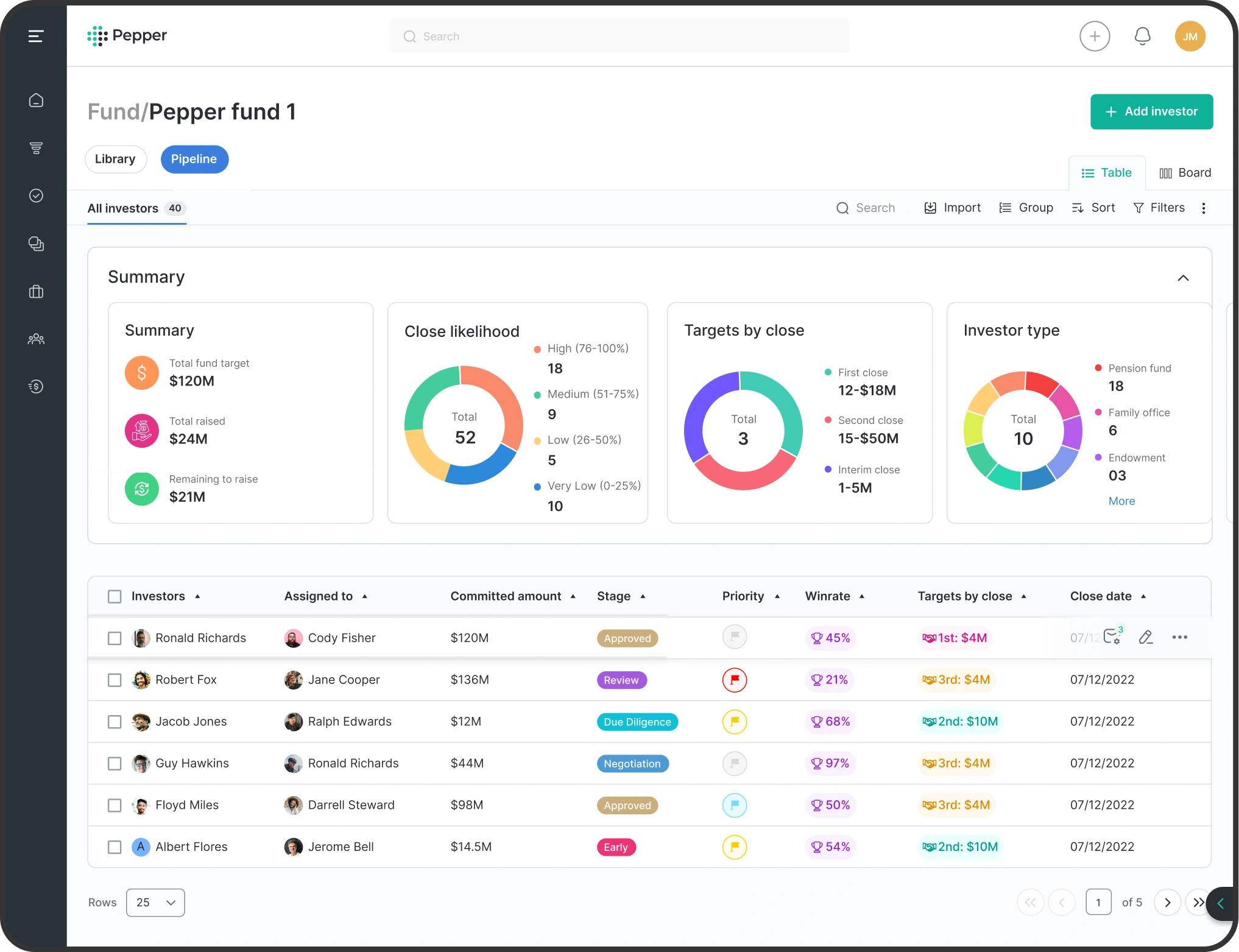

Pepper AI operates on the structured LP data your team has built in the platform — allocation records, communication logs, performance data — turning hours of manual LP relationship work into minutes of review and approval.

First-draft LP communication templates assembled from structured allocation and performance data — your IR team personalises and sends. Communication quality improves; drafting time drops.
Time saved: 2–4 hours per LP communication cycle

Engagement patterns across your LP base analysed continuously. LPs showing reduced engagement — fewer logins to the portal, fewer responses to communications — flagged before the relationship deteriorates.
Use case: Early warning before re-up risk becomes visible

When an LP submits a question about their allocation, performance, or capital activity, Pepper AI drafts a data-grounded response for your IR team to review and send — reducing response time from days to hours.
Time saved: Same-day LP query resolution from days

Thought Leadership
July 29, 2026
AI Insights
July 29, 2026

White Paper
July 29, 2026
See how private credit managers use Pepper to calculate NAV from the same data that governs each credit agreement — not reconstructed from it.
Biweekly insights on market trends, operational best practices, and platform intelligence - delivered to your inbox

By providing your email, you will shortly receive the latest report from Pepper.
In a 45-minute session, we'll walk you through how Pepper handles the workflows your team runs today — deal management, portfolio monitoring, fund operations, or LP reporting. You pick the priority.
Not a sales call. A 30-minute conversation with a Pepper practitioner about where your operation is today, where the pressure points are, and whether a platform approach makes sense for your stage of growth.