


Get our report on investing trends!
By providing your email, you will shortly receive the latest report from Pepper.
The quarterly PDF report is not becoming obsolete — it is becoming one output format among several, and the infrastructure required to produce the others is changing what institutional LP communication means.


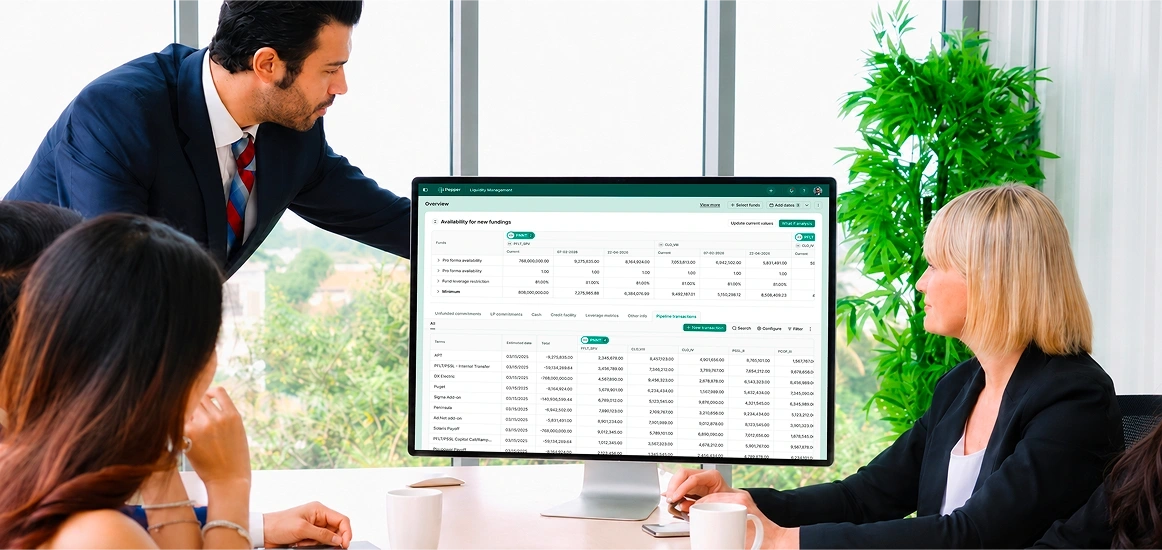
Most private credit and alternative asset managers begin their operating life with reporting infrastructure built on spreadsheets. The quarterly LP report is assembled by a skilled operations analyst in two days, reviewed by a partner, and distributed. The process is manual but manageable. At some point — typically between $500M and $1.5B AUM, or between 20 and 50 LP relationships, or when the LP base begins requesting customised data cuts and ESG-specific reporting — the spreadsheet infrastructure stops being manageable and starts being an operational risk.
The inflection point is predictable. The preparation for it is not — and the managers who begin preparing for it before it arrives spend significantly less to address it than the managers who begin after it forces the issue.
Data reconciliation time grows linearly with portfolio size. Each additional private credit position requires additional data collection from multiple sources, reconciliation between the fund administrator’s records and the internal portfolio monitoring data, and review before the report is distributed. A process that takes one operations analyst two days at 20 positions takes two analysts four days at 60 positions. At 100 positions, the same process requires a team that is spending most of its quarter-end time on reporting mechanics rather than investment support.
LP customisation becomes unmanageable. As the LP base grows and institutional investors begin requesting LP-specific reporting — portfolio exposure breakdowns by sector, ILPA-formatted data packages, ESG metrics mapped to mandate-specific frameworks — the manual reporting process cannot scale. Each customisation adds production burden. Each additional format adds an error surface. Each additional LP report version is an additional reconciliation step before distribution.
Error rates in distributed reports increase. The more manual steps in the reporting process, the more opportunities for errors to propagate from data source to report. A number copied from one spreadsheet to another, a period-over-period comparison that uses different base periods, a position value that reflects the fund administrator’s data rather than the portfolio monitoring data — these errors are difficult to catch in a manual review process and expensive when LPs discover them. Gartner estimates poor data quality costs the average organisation $12.9 million annually; the 1-10-100 rule of data quality management applies: an error costs 1x at entry, 10x downstream, and 100x after it has reached an external stakeholder.
LP delivery timeline extensions. As the reporting process becomes more complex — more positions, more LP-specific formats, more data sources to reconcile — the quarter-end reporting cycle extends. A process that delivered in 14 days at $500M AUM delivers in 40 days at $2B AUM because the manual process has not been replaced by systematic infrastructure. LPs notice. In the institutional LP market, a 40-day delivery timeline is now a competitive disadvantage.
The migration sequencing that produces successful outcomes
Allvue Systems’ 2026 research on operational scaling in private credit and alternative asset management found consistent evidence that broad, enterprise-wide transformation programs stall while targeted initiatives against high-friction workflows deliver measurable value. The same finding applies to reporting infrastructure migrations.
Step one: define the canonical data model. Establish a single authoritative source for every data element in every LP report — position values, capital activity, performance metrics, covenant compliance data. This is a governance decision as much as a technology decision. Until data ownership is established — which team is responsible for which data, which system is authoritative — no automation built on top of the data will be reliable.
Step two: connect to the fund administrator through a structured API integration, eliminating the export-and-reconcile step between fund administration and reporting. This single integration eliminates the most common source of reporting data errors and is typically the highest-friction workflow in the existing manual process.
Step three: configure LP report templates from the unified data model, replacing the manual assembly process. Purpose-built private credit reporting platforms provide pre-built templates calibrated to ILPA reporting standards and standard private credit LP report formats, reducing template configuration to adjustment rather than construction.
Step four: implement AI narrative generation, converting the quarterly narrative drafting burden from a writing task to a review and personalisation task.
Step five: extend to LP portal access and structured data delivery, enabling continuous transparency and satisfying institutional LP data infrastructure requirements.
AI accelerates the reporting infrastructure migration at two specific points. First, in the data migration: AI document intelligence processing historical credit agreements, fund administrator reports, and borrower financial statements extracts and structures the historical data that needs to be migrated into the new data model. This is faster and more accurate than manual data entry, and it produces structured output that can be validated against source documents.
Second, in configuration validation: AI narrative generation from the new structured data model, compared to the most recent manual reports, immediately reveals whether the data model is correctly configured. Discrepancies between the AI-generated output and the manually produced historical reports identify data model gaps or configuration errors before the new system goes live. The AI validation step is faster and more comprehensive than the configuration testing that manual processes allow.
The ROI case: beyond time savings
The ROI case for reporting infrastructure investment is typically framed as a time-saving argument: hours saved on report production multiplied by analyst cost equals payback period. This frame understates the total value.
The more significant value components are LP retention quality (institutional-grade reporting infrastructure demonstrates the operational maturity that sophisticated institutional LPs evaluate at re-up), error risk reduction (the cost of a material reporting error after LP distribution is measured in relationship damage, not just correction cost), and AUM scalability (the operational cost of each incremental LP relationship drops dramatically with systematic infrastructure, enabling growth without proportional headcount growth).
At AUM above $1B in private credit or alternative asset management, the combination of these factors typically produces a payback period of under 12 months for reporting infrastructure investment. Below $1B, the payback period is longer but the strategic value — the ability to grow through Stage Two without rebuilding the reporting infrastructure — is significant for managers with fund-over-fund growth ambitions.
Pepper replaces the fragmented middle of the reporting stack — the manual reconciliation between the fund administrator and the portfolio monitoring system, the per-LP spreadsheet assembly, the parallel data sources — while connecting through APIs to the fund administrators, prime brokers, and data providers a firm already uses. Reports are generated directly from the live data model. AI narrative generation, anomaly detection, and natural language query operate on the same governed data layer as deal management and portfolio monitoring.
Articles
August 20, 2026

Articles
August 20, 2026
Articles
August 20, 2026
Sign up for our newsletter to receive biweekly updates on the world of asset management, delivered straight to your inbox.

By providing your email, you will shortly receive the latest report from Pepper.
In a 45-minute session, we'll walk you through how Pepper handles the workflows your team runs today — deal management, portfolio monitoring, fund operations, or LP reporting. You pick the priority.
Not a sales call. A 30-minute conversation with a Pepper practitioner about where your operation is today, where the pressure points are, and whether a platform approach makes sense for your stage of growth.