


Get our report on investing trends!
By providing your email, you will shortly receive the latest report from Pepper.
The export step — the moment portfolio data leaves the system that holds it and enters the template that needs it — is where private credit LP reporting goes wrong, and eliminating it is what AI-powered reporting actually means.


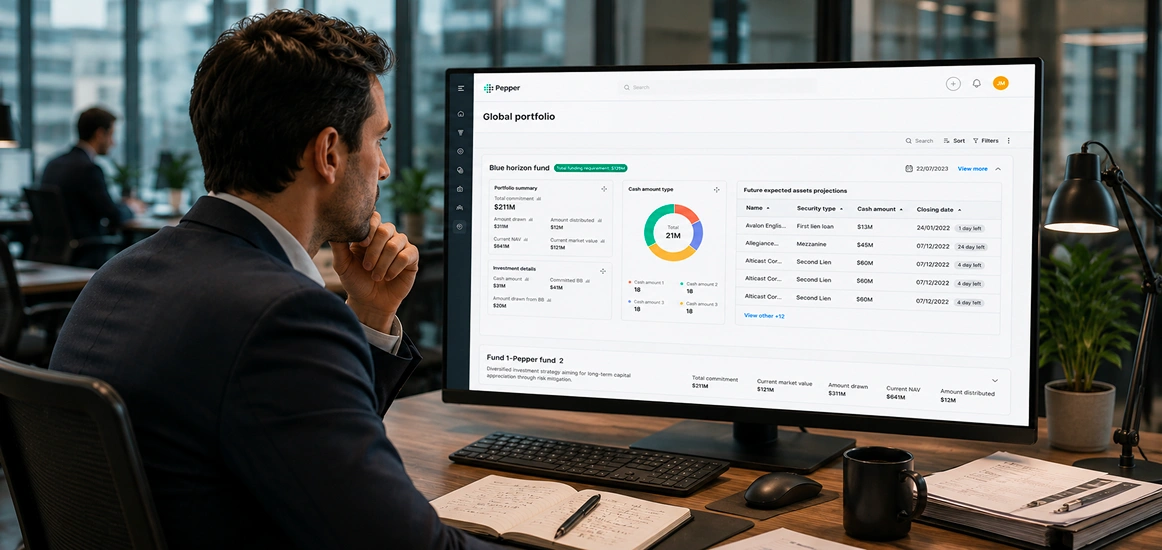
The information memorandum is 90 pages. Healthcare services company. $45M EBITDA. Three platform businesses. The investment director has never met the management team. Without AI: the analyst spends Thursday morning populating the financial model from the IM. Three hours of data entry before any analytical work. With AI document intelligence designed for private equity CIM processing: revenue, EBITDA, margin history, leverage profile, management team, capital structure, and competitive positioning are extracted, structured, and mapped into the deal model overnight. The analyst reviews the extracted data Thursday morning and begins the analytical work immediately.
The time saving — two to three hours per deal — compounds across a high-volume deal team processing 200 to 300 new opportunities per year. More importantly, the analyst’s cognitive engagement with the deal begins at the analysis stage rather than the data entry stage. The quality of the initial assessment improves.
Without AI: the analyst spends Sunday formatting financial tables, cross-referencing numbers across multiple model outputs, organising sections in the IC memo template, and ensuring consistency between the narrative and the exhibits. The analytical work — testing the investment thesis, sharpening the risk analysis, arguing the conviction — is a minority of the Sunday spent on IC memo preparation.
With AI IC memo drafting from structured deal data: the first draft of the IC memo is assembled from the deal record — financial summary, company overview, market analysis, investment thesis framing, risk factors, proposed terms and structure. The analyst arrives at Sunday’s work with a structured starting point to react to rather than a blank page to fill. Sunday goes to analytical challenge: testing the thesis, identifying the risks the first draft missed, arguing about conviction. The IC meeting on Thursday is better because the preparation on Sunday was better.
The entry multiple question: what is the right entry price? The analyst needs comparable transactions — similar healthcare services businesses, similar EBITDA scale, similar sponsor dynamics, comparable leverage. The reference set should be as broad and systematic as possible.
With AI comparable transaction surfacing from structured deal history: the system identifies historical private equity transactions from the fund’s own deal records that match defined criteria — sector, EBITDA scale, sponsor quality, leverage multiple, entry timing relative to credit cycle. The pricing team reviews a documented, systematic reference set rather than whatever the most experienced deal team member can recall. The pricing analysis is better because the reference set is better.
Without AI: the operating partner reads the quarterly financials before the board meeting, calculates key metrics, and arrives at the board meeting forming a view from manual analysis. The metrics that matter — EBITDA margin relative to the acquisition model, working capital relative to the pre-close baseline, revenue growth relative to the investment thesis — are calculated by hand the morning before the meeting.
With AI portfolio company monitoring: the financials were processed when they arrived last week. EBITDA variance against the acquisition model was flagged immediately, along with a note that this is the second consecutive quarter of underperformance. Gross margin compression was identified and traced to specific cost categories visible in the management accounts. The operating partner arrives at the board meeting having already engaged with the analytical questions — with specific, data-grounded questions for the management team rather than discovery questions formed from the morning’s manual calculations.
Without AI: the IR team writes quarterly narratives for 45 LP relationships over three to four weeks. With AI narrative generation from structured portfolio data: first-draft narratives for all 45 LPs are produced from the live portfolio monitoring data — specific to each LP’s actual fund allocations, reflecting the actual performance of their specific positions. The IR team reviews, personalises for LP-specific relationship context, and approves. Four weeks of writing becomes one week of review.
AI does not make private equity investment decisions. At every moment described in this piece, the judgment — whether to pursue the deal, how to argue the IC thesis, what the pricing reference implies, what the board meeting data means, how to frame the LP narrative — belongs to the investment professional. AI changes what is on their desk when they make it.
Pepper’s AI capabilities — document intelligence, IC memo drafting, comparable transaction surfacing, financial deterioration detection, board package generation, and LP narrative generation — all operate on the same governed data layer. The investment in AI is the return on the investment in data architecture. The platform came first.
Articles
August 20, 2026

Articles
August 20, 2026
Articles
August 20, 2026
Sign up for our newsletter to receive biweekly updates on the world of asset management, delivered straight to your inbox.

By providing your email, you will shortly receive the latest report from Pepper.
In a 45-minute session, we'll walk you through how Pepper handles the workflows your team runs today — deal management, portfolio monitoring, fund operations, or LP reporting. You pick the priority.
Not a sales call. A 30-minute conversation with a Pepper practitioner about where your operation is today, where the pressure points are, and whether a platform approach makes sense for your stage of growth.