


Get our report on investing trends!
By providing your email, you will shortly receive the latest report from Pepper.
The spreadsheet infrastructure that serves a private equity fund well at Fund II stops serving it at Fund III — and the managers who wait for the breaking point to start the migration pay significantly more to fix it than the managers who begin before the infrastructure breaks.


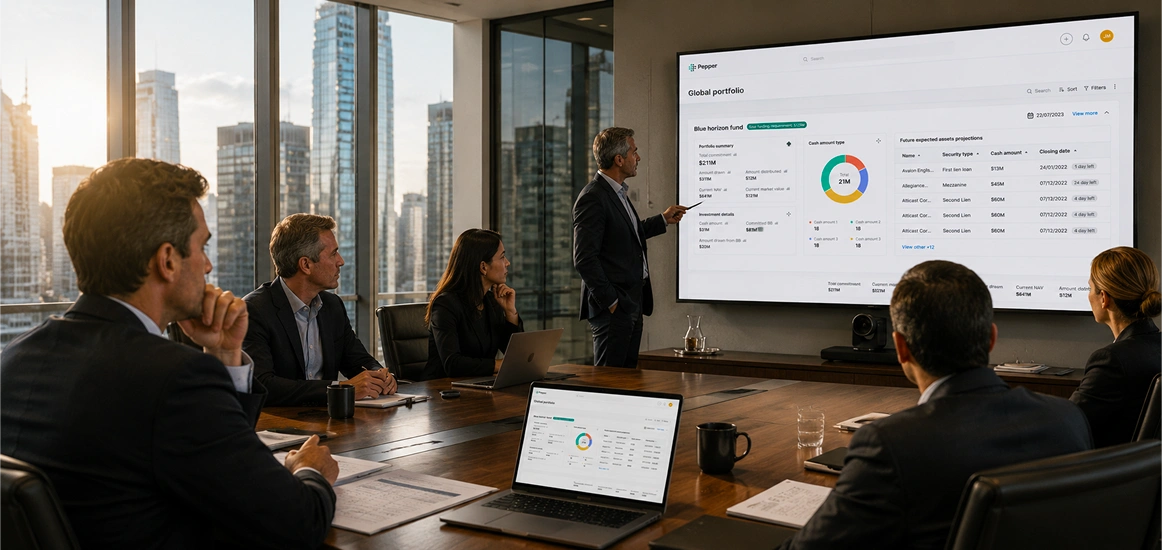
Most private equity firms begin their operating life with data infrastructure built on spreadsheets. In the early stages — Fund I, 8 to 10 portfolio companies, 20 LP relationships, one or two partners managing everything — Excel is flexible, familiar, and adequate. At some point — typically as Fund III is being raised, the portfolio grows past 20 companies, and LP relationships pass 40 — the spreadsheet infrastructure stops being adequate and starts being an operational risk.
The failure is not dramatic. It is a slow accumulation of friction: the reconciliation step that takes three hours instead of one, the report that goes out with an error, the portfolio company financial data that was not updated before the board meeting, the covenant test that was missed because the monitoring spreadsheet had not been updated since the last amendment. Each failure is individually manageable. The pattern they form is not.
Deal data not flowing forward at close. Deal data captured during due diligence — the financial model, the investment thesis assumptions, the credit agreement terms for any debt financing, the management team assessment — lives in a deal folder and is disconnected from the portfolio monitoring workflow. At close, someone creates the monitoring baseline manually from the due diligence materials. This manual creation step is where the first gap between what the due diligence process determined and what the portfolio monitoring system reflects is introduced. The valuation model baseline used for the first quarterly portfolio company monitoring review was created by hand from memory of the deal — not automatically from the deal record that the due diligence process produced.
Portfolio company monitoring quality declining with portfolio size. At 10 portfolio companies, a senior partner maintains current qualitative awareness of every company’s performance through direct engagement. At 20, the same awareness requires operating partners and board representatives, and the consistency of monitoring quality across the portfolio begins to vary. At 30 to 35 companies, the monitoring process is formally adequate — quarterly board meetings, quarterly financials reviewed — and materially insufficient for detecting the early-stage deterioration that is most costly to miss. The companies in the early stages of underperformance receive the same monitoring attention as the companies performing in line with plan — because they have not yet flagged.
LP reporting timeline and quality degradation. Each additional LP relationship, each additional report format, each additional LP-specific customisation adds to the manual production burden of quarterly LP reporting. At 20 LP relationships, the reporting cycle consumes one week. At 50, it consumes three weeks. At 80, it consumes the entirety of the time available between quarter-end and LP distribution — and it crowds out the operational attention that should be going to portfolio company management and deal origination.
Allvue Systems’ 2026 research on operational scaling in private credit and alternative asset management found consistent evidence that broad enterprise-wide transformation programs stall, while targeted initiatives against high-friction workflows deliver measurable value. The same finding applies to private equity data infrastructure migrations.
Step one — close the deal-to-monitoring handoff gap. This is the highest-priority step because it is the source of the most consequential errors and the most persistent reconciliation work in PE operations. The canonical deal record — what the due diligence process determined about the company, the deal structure, and the investment thesis — should flow into portfolio monitoring at close without re-entry. This requires a deal management system and a portfolio monitoring system that share a data layer, or a unified platform that handles both.
Step two — establish the portfolio company data model. Define what financial and operational data is collected from each portfolio company, at what frequency, in what format, and who is responsible for maintaining it. This is a governance decision that must precede any technology decision. Until data ownership is established across the portfolio management team, no monitoring infrastructure built on top of it will be reliable.
Step three — connect to fund accounting. The integration between portfolio monitoring data and the fund administrator’s capital account records is where most manual reconciliation work in PE operations originates. A structured API integration that eliminates the export-and-reconcile step between fund accounting and portfolio monitoring eliminates the largest single source of LP reporting data errors.
Step four — implement AI-powered portfolio monitoring. AI financial deterioration detection, EBITDA variance tracking, and working capital trend monitoring begin delivering value immediately after the portfolio company data model is configured. The first quarter of portfolio company data flowing into the new system starts generating AI signals — early warning signals that direct operating partner attention to the companies that need it.
Step five — implement AI-powered LP reporting. AI narrative generation from the unified portfolio data model, combined with LP portal access, converts the quarterly reporting cycle from a manual production process to a review and personalisation process. The reporting cycle compresses. LP reporting quality improves. The LP management team’s time shifts from production to relationship management.
AI accelerates the PE data infrastructure migration at two specific points. In the data migration, AI document intelligence processing historical deal files — information memoranda, financial models, board packages — extracts the structured data that needs to be migrated into the new platform faster and more accurately than manual data entry. In the configuration validation, AI-generated first drafts of LP reports from the new data model, compared to the most recent manually produced reports, immediately reveal data model configuration gaps or errors before the new system goes live.
Pepper closes the deal-to-monitoring handoff gap: deal records at origination flow into portfolio monitoring at close, with no re-entry. Portfolio company financial data flows from monitoring into LP reporting without an export step. AI financial deterioration detection, portfolio company monitoring, and LP narrative generation all operate on the unified data layer. Pepper connects through APIs to the fund administrators and data providers a firm already uses — replacing the fragmented middle, not the institutional infrastructure a firm has built.
Articles
August 20, 2026

Articles
August 20, 2026
Articles
August 20, 2026
Sign up for our newsletter to receive biweekly updates on the world of asset management, delivered straight to your inbox.

By providing your email, you will shortly receive the latest report from Pepper.
In a 45-minute session, we'll walk you through how Pepper handles the workflows your team runs today — deal management, portfolio monitoring, fund operations, or LP reporting. You pick the priority.
Not a sales call. A 30-minute conversation with a Pepper practitioner about where your operation is today, where the pressure points are, and whether a platform approach makes sense for your stage of growth.