





Thought Leadership
July 28, 2026


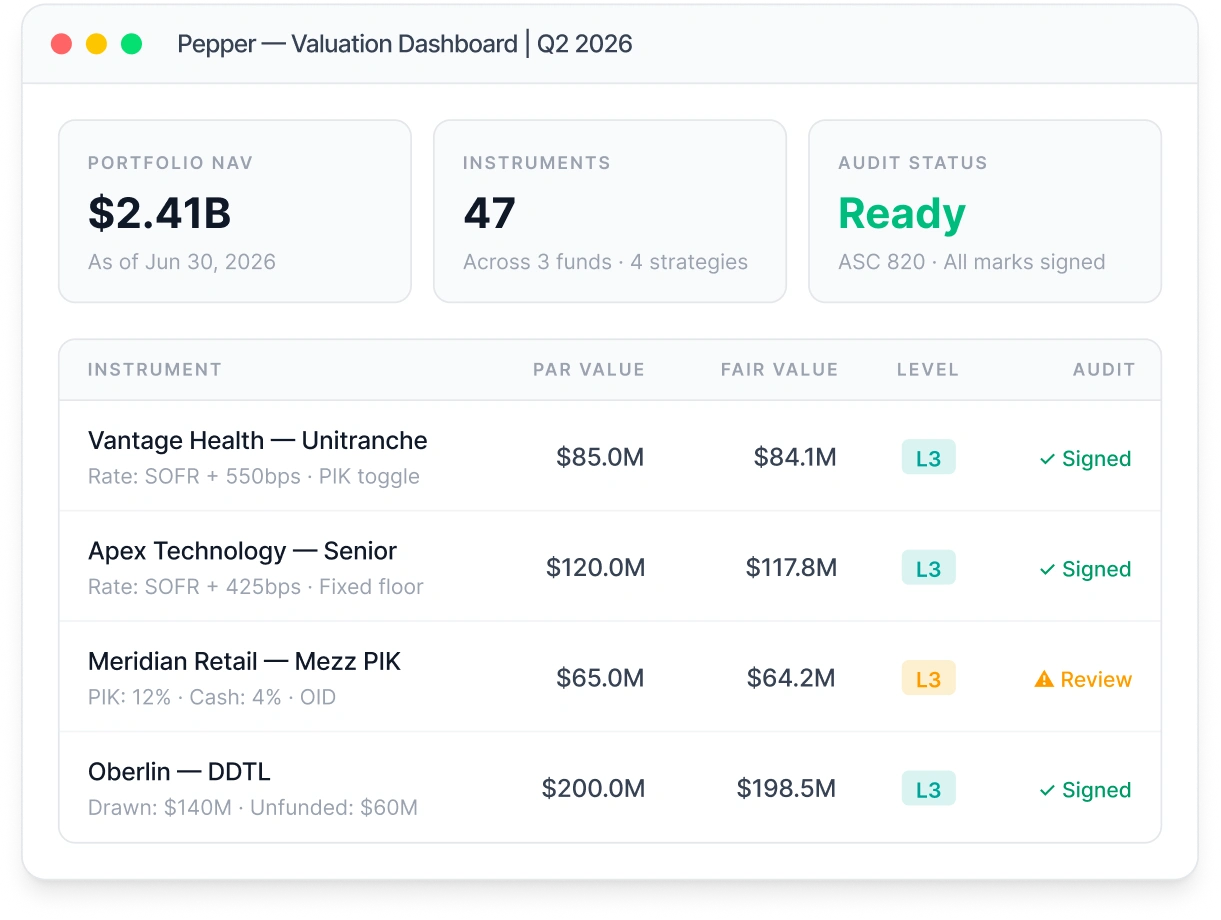


Pepper's valuation module captures the exact economic terms of each instrument and applies valuation logic that matches how private credit assets are actually structured. The result: NAV calculations that are accurate on any given day, not just at quarter-end.
Most portfolio valuation tools require a manual transcription step - instrument terms into a separate model. That's where errors enter, marks diverge from agreements, and audit exposure begins. Pepper eliminates it.

Every instrument's economic terms captured at origination — principal, rate type, PIK toggle, floor, spread, maturity, and tranche structure — flowing directly into valuation logic without manual re-entry.

Individual instrument valuations calculated from live credit agreement terms, draw schedules, and market inputs — with full drill-down from portfolio-level NAV to individual position to underlying cash flow.

Position-level valuations aggregated automatically into fund-level, vehicle-level, and multi-fund consolidated views — with roll-up logic that respects each fund's structure, currency, and ownership percentage.

Multi-currency portfolios valued with real-time FX inputs applied consistently across positions — eliminating the currency translation errors that arise when different team members apply different exchange rate sources.

Full visibility into delayed-draw term loans, revolving facilities, and multi-tranche structures. Capital committed versus drawn, unfunded obligations, and draw conditions tracked in real time — no manual reconciliation between the credit agreement and the monitoring record.

Configurable LP dashboards providing each investor with real-time visibility into their allocations, performance, capital activity, and document library — without requiring a manual report cycle.

Internal DCF models, external third-party appraisals, yield-based pricing, and market-comparable approaches applied by instrument type — with model selection logic configurable by asset class, strategy, and fund governing documents.

 AI-powered
Portfolio-level mark trends, unrealised gain/loss attribution, vintage performance dispersion, and fair value sensitivity analysis — generated from live valuation data, not a separate analytics extract.

IC valuation memos, board-level portfolio marks, LP-facing fair value disclosures, and regulatory filings generated directly from the valuation system — with sign-off workflow and audit trail embedded.

ASC 820, IFRS 13, and SEC valuation policy requirements addressed directly in Pepper's valuation framework — with documentation, policy linkage, and sign-off workflow required for audit defence.

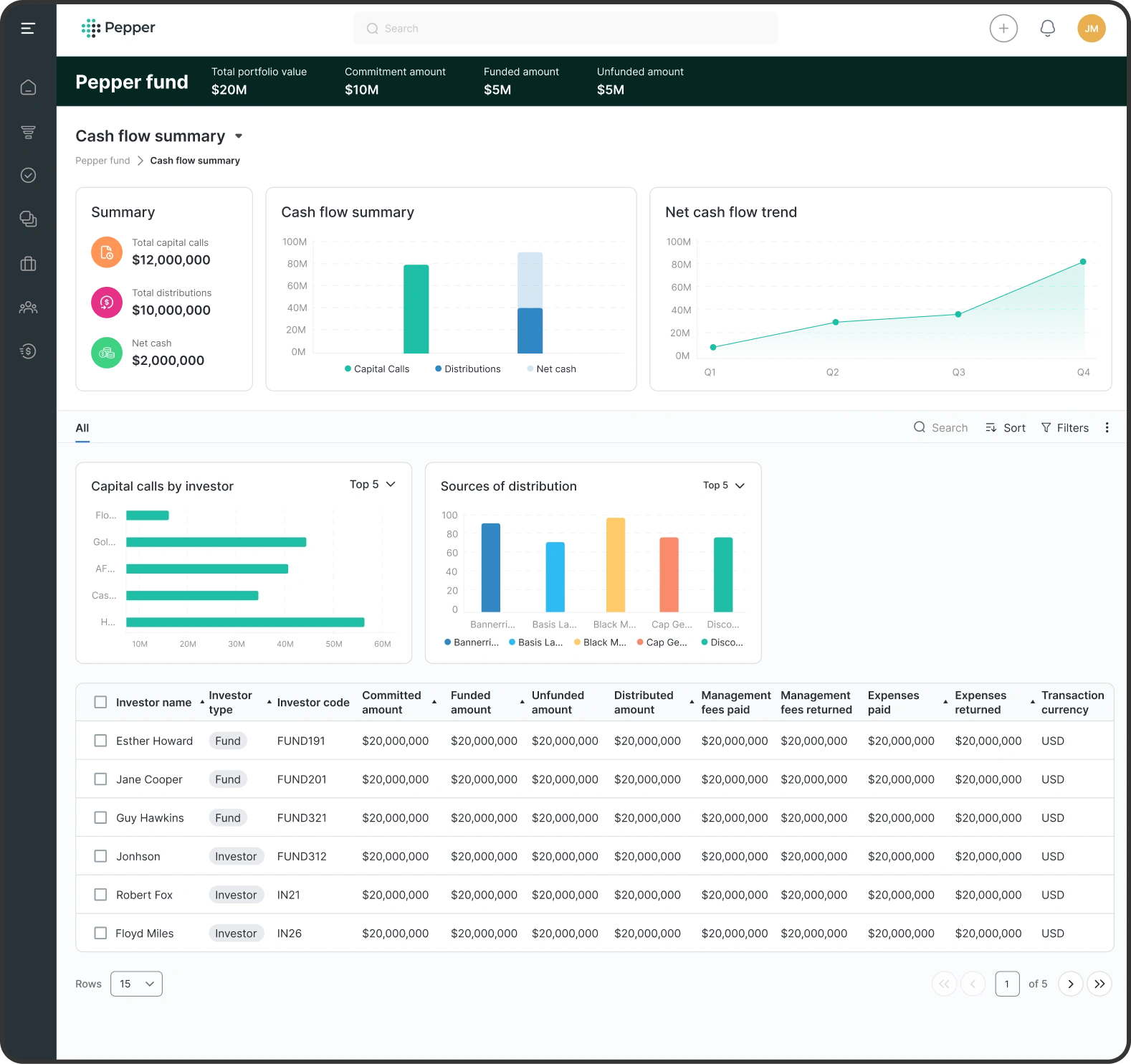
Real-time portfolio valuation dashboards for investment teams, IC, and fund administrators — showing NAV by fund, strategy, vintage, and currency — configurable to each audience's decision context.

Pepper AI operates on the structured valuation data your team has built in the platform — mark history, model inputs, credit agreement terms — making its outputs verifiable and audit-defensible in a way that generic AI tools cannot match.

PIK interest compounding and delayed-draw funding milestones tracked automatically against each credit agreement. No manual reconciliation. No discrepancy between what the agreement says, what the model projects, and what the monitoring record shows.
Use case: PIK compounding, DDTL milestone tracking, draw condition monitoring

AI-flagged statistical anomalies in portfolio marks — period-over-period movements outside expected ranges, valuations inconsistent with comparable instruments, and data inputs that diverge from historical patterns — reviewed before marks go to LP or IC.
Use case: Valuation QA before LP distribution and audit

When marking an illiquid position, Pepper AI surfaces comparable transactions from your deal history and available market data — giving your valuation team defensible reference points without manual research.
Output: Defensible comps from your own deal history — audit-ready

First-draft fair value disclosure narratives and Level 3 valuation methodology descriptions assembled from structured valuation data — your team reviews, edits, and approves for IC memo and LP report inclusion.
Time saved: Hours off quarterly disclosure preparation

Thought Leadership
July 28, 2026

AI Insights
July 28, 2026

White Paper
July 28, 2026
See how private credit managers use Pepper to calculate NAV from the
same data that governs each credit agreement — not reconstructed
from it.
Biweekly insights on market trends, operational best practices, and platform intelligence - delivered to your inbox

By providing your email, you will shortly receive the latest report from Pepper.
In a 45-minute session, we'll walk you through how Pepper handles the workflows your team runs today — deal management, portfolio monitoring, fund operations, or LP reporting. You pick the priority.
Not a sales call. A 30-minute conversation with a Pepper practitioner about where your operation is today, where the pressure points are, and whether a platform approach makes sense for your stage of growth.